Check out highlights of various talks at same YouTube channel
November 17, 2014


November 15, 2014
November 14, 2014
NEW DVD: "PURGATORY: THE FORGOTTEN CHURCH"
 |
| Order DVD and watch trailer: www.PurgatoryForgottenChurch.com. |
The Church has a custom of praying for those we don’t know,
also, just generally praying for “the souls in purgatory,” “the poor souls,”
and “the most forgotten souls in purgatory” who may have no one praying
specifically for them. Why do we call them “suffering” souls? Because they are
in intense spiritual agony, longing to be with God. At death they met Him,
everything has been clarified for them (what is truly of value, where their
desires should be directed), and the “suffering” is simply an overwhelming
desire to be with Him.
Why do the souls in purgatory need our prayers? While we’re
on earth we have free will, right up till the moment of death. After death, the
souls in purgatory can no longer “help themselves,” so our prayers can avail
them. In turn, their prayers and sufferings are precious to God and are able to
help us. Such is the “communion of saints” and the interconnectedness of the
Church, the Mystical Body of Christ.
Chicago-based filmmaker, Friar John Clote, an investigative
journalist before he entered the Conventual Franciscans, has delved extensively
into this subject to produce a comprehensive 75-minute film filled with
authoritative information and inspiration. Cardinal George is interviewed along
with great “friend of the holy souls,” Susan Tassone, and others.

I recently interviewed Friar John for Chicago’s Archdiocesan
Catholic newspaper, “The Catholic New World.” (Twitter: @CathNewWorld)
CNW: What inspired you to make this film?
John: I’ve been interested in this subject for years. My Mom
passed away in 2008, and that experience of being a grieving Catholic, and
having Masses said for her, that made me think about how I would approach this
in a film.
I began praying in a Eucharistic chapel in Arizona, praying
for my Mom and Dad and all the people I knew who had passed away, friends of my
family and my friends. I began thinking of people who weren’t like my Mom who
had many people praying for her. She had lots of friends who were devoted,
prayerful Catholics. I kept thinking of deceased people I knew who didn’t have
these people in their lives.
CNW: What did you learn in the process of making this film?
John: There’s a spiritual connection that exists between the
living and deceased: Earth, purgatory and heaven. The theological definition is
“the communion of saints,” but there can also be a tangible component sometimes
when the veil between this world and the next thins in varied ways, in
beautiful ways that can lead one to believe or reconsider unbelief that there
really is something beyond this world.
In the film, we talk about near-death experiences and the
development of the Church’s doctrine on purgatory. The idea of purification
after death is not unique to Catholicism. The ancient Greeks had an idea of it,
too.
CNW: How has making
this film changed you?
John: It has reinforced for me the specific notion that our
relationships don’t end here. The love and appreciation—even though we are
missing the sense of people’s physical presence—doesn’t end, but translates
into a higher form of communication through prayer. I believe the deceased in
purgatory can hear us more clearly, understand us more profoundly, and pray for
us.
CNW: What are some misconceptions about purgatory?
John: First, that it doesn’t exist, and second, that it’s
some kind of antechamber of hell, that it’s “down there” with some kind of trap
door to get out. The four misunderstandings that we deal with in the film are:
1) time and space 2) indulgences 3) suicide 4) the motif of fire as the chief
form of purgation. Much of the Church’s art, especially from the Middle Ages,
depicts purgatory as fire. The focus really is on God’s love, God’s love as
consuming fire coming from His Sacred Heart. That kind of fire. Nothing impure
will enter heaven. We will be with an all-holy God, so His love needs to purify
us so that we can become a reflection of
who God the Father really is.
CNW: What do you want people to take away from the film?
John: Jesus Christ
has unfathomable mercy and love for His Creation and all of us, and we need
only ask to be enveloped in that Love. Purgatory is just another expression of
God’s profound, unfathomable, incomprehensible mercy.

John B. Clote is a
Conventual Franciscan friar, broadcast journalist and filmmaker. He is
currently studying to be ordained to the Catholic priesthood. After several
years as a producer and writer at NBC News in St. Louis he began working in
catholic media producing more than a dozen films and documentaries for The Mercy
Foundation. John was one of the last journalists in the world to conduct a
televised interview with Blessed Mother Teresa of Calcutta and Saint Faustina
Kowalska’s last surviving sibling. His films and work have appeared on NBC,
ABC, CBS, PBS, and EWTN.
November 12, 2014
November 11, 2014
MEET THE DAUGHTERS OF ST. PAUL IN ST. LOUIS!
This video was handmade with love by our Postulants, who may or may not be starting
a production company called "Shake & Bake."
a production company called "Shake & Bake."
November 2, 2014
MOVIES: "GONE GIRL"
Afterthought (February 2015): I finally figured out what's wrong with this film! No versimilitude!
"Versimilitude is the guardrail that keeps us from crashing into the abyss of disbelief."--Hal Ackerman, Screenwriting, UCLA. This film pretends at reality but it's all surreality.
AN INTRIGUING PREMISE
I don't know why this simple premise intrigued me when the best-selling book and now movie, "Gone Girl" first came out, but it did: A young married couple. The wife suddenly disappears. Was it murder? Did her husband do it? But alas, the film, for all its accolades, is a massive disappointment, and really, a failure as a film. My biggest beef is with the ending which makes no sense. No sense. Way beyond a plot hole. [Disclaimer: I have not read the book, but am told it ends the same way.]
SPOILERS
There is no way to do this review without spoilers--given the thin premise--but I will jump around and be as sketchy as I can. Several things about this film make it feel amateurish (although I like other David Fincher films). The author of the book, Gillian Flynn, also wrote the screenplay (not bad for a first-time screenwriter, but it shows). Maybe this is part of the problem. The offbeat casting actually does work: Tyler Perry as a high-powered lawyer; Neil Patrick Harris as a wealthy, obsessed fanboy; homey and likeable unknown (but not for long!) Carrie Coon as the husband's twin brother.
There are two main characters: both husband and wife double-narrate their own point of view throughout, although it leans much more to the wife at a certain point, especially since she keeps a diary that provides much of the voiceover.
CASTING & MIS-CASTING
Ben Affleck does not work in the lead role of husband, and I even question Rosemund Pike as the wife. Affleck is a one-note actor who often blurts his lines without truly grasping the emotion or the moment. Everything about Pike is always pristine (which this part calls for), but I'm not sure that either Affleck or Pike grasped the intricate dance that the story was all about--unless I read more richness into the story than is there. Affleck NEVER changes, and Pike only changes from beleaguered wife to full-out psycho which seems SHOULD have been a much slower, more gradual reveal. I thought we could really have commiserated with the wife over the affair, and been made to think that that was the real issue for a while.
You see, ONCE we know that the wife is a full-on psycho, she can longer be THE main character. Screenwriting 101 Rule #1: criminally insane people do not make good main characters because nothing will stop them. They are capable of anything. There is often no real logic to their motivations or actions, as meticulous as they may be. Even if there is a powerful, dangerously crazy, scene-stealing antagonist (Hannibal Lecter, the Joker, any "monster" in a horror film) in a movie, they are offset by a sane protagonist.
MORE SPOILERS
BIG SPOILER ALERT! The ending makes absolutely no sense. Why in heaven's name does the husband stay with her?* He was exonerated. There was absolutely no need at all. The entire story breaks down at this point and veers into ridiculousness. But audiences seem to "just go with it" which is scarier to me than the broken story. I know our society struggles to reason and think logically, but audiences have always been tough on films with shoddy plot points. Maybe guys give it a pass because it's a woman-scorned-chick-flick-dark-drama-but-God-help-you-if-pulled-something-like-this-with-Star-Wars. But gals? Thinking caps?
The brief sex scenes/nudity are not as graphic as they were drummed up to be, but one bloody violent scene is deeply disturbing. There are other problems with the film: it's choppy, a tad boring, the beginning and ending music is odd and drowns out the dialogue, the characters are not fully fleshed out: people talk and talk and talk about who they are and who everyone else is, but we never actually SEE them acting that way. We never really grasped who this couple was (even though they were not always true to themselves) which is essential for the audience investing in them and the story.
Screenwriting 101 Rule #2: "Show, don't tell." Screenwriting 101 Rule #3: The audience MUST care about the characters because the filmmakers have made us feel like we know them and can relate somewhat (even if they aren't sympathetic characters). The script/dialogue is definitely a writer's script: fancy verbal sparring at all times. Even the cop uses "meta." Really? The urgency of the film doesn't kick in for quite some time (the music could have been used more effectively hear to build tension).
There was some fun layering of plots (the flashbacks, the diary itself, the "treasure hunt" of clues) but the wife's parents were, like, extra appendages or something. They served no purpose. That might be allowed in novels, but not in films. Or if their purpose was that the wife's life wasn't quite "reality" from the beginning because of them, that needed to be played up.
2 THUMBS DOWN
I love good suspense-thrillers, but "Gone Girl" just feels generally gratuitous, precious and precocious. And, it's just a nasty piece of work. It also felt like a film that could easily have been made for the small screen.
The most chilling message of the film is: If you turn love into a game, if you are not yourself before or after marriage and neither is your spouse--whom did you just marry? Few of us will experience a "war of images" on national TV, but it does give one pause to wonder what other (perhaps even insincere) "images" we portray of ourselves that "do battle" for us?
Even more chilling (and strange), in interviews with Flynn and in reviews, people are treating this depiction of a crazed woman and a seriously messed-up relationship as, well, normative: "Yeah, that's marriage for ya."
My head hurts. I rarely tell people to save their money and not go see a film, but I'm gonna say it about this unentertaining turkey. But have all the turkey you want later this month.
____________
*See "comments." The book evidently makes it much clearer why he stayed.
____________
*See "comments." The book evidently makes it much clearer why he stayed.
OTHER STUFF:
--I am dreading Batman.
--Canadians loved the Winnipeg joke. (Saw this in a Toronto theater.)
--I'm sorry. Maybe this is mean, but when Ben Affleck's character is being coached by Tyler Perry (the lawyer) not to look smug on camera...well...I just couldn't stop laughing because...well....
--I couldn't help feeling that this film comes from a woman writer trying to prove that she can write as rough and shocking as any man. As if that's what it means to be a man.
--I couldn't help feeling that this film comes from a woman writer trying to prove that she can write as rough and shocking as any man. As if that's what it means to be a man.
--There is talk of a sequel. A sequel to Gone Girl makes even less sense than the ending of GG. Unless the point is that society has gone insane. Especially at the male/female, marriage/family level. I'm serious.
SR. HELENA'S 10 RULES
FOR HOW TO NEVER FIND TRUE LOVE
1. separate love and
sex
2. separate sex and marriage
3. separate sex and fertility
4. make love and sex a game
5. postpone marriage for as long as you can (and make "marriage" about a really expensive
wedding)
6. make marriage about finding the perfect sexual partner
7. try to put love, sex, marriage and fertility all back together again right
before you get married
8. pretend that marriage is a magic wand that will suddenly make you: know how
to be faithful, achieve sexual self-mastery, know how to unselfishly sacrifice
for your husband/wife/children, stop looking around, stop flirting around, stop
hooking up--when you have actually been "in training" for "the
opposite of marriage" all this time
9. even after you get married, stay open to finding "the one,"
because you can never be sure you married "the one"
10. if the person you married doesn't constantly fill all your needs, start at
#1 again.
2. be the kind of person you'd want to marry
3. practice chastity=integration of body and soul, sexual honesty, sexual self-mastery
4. within your marriage, make love and sex a lifelong art
5. get married "young" if you find the love of your life "young." build your life together, not apart
6. make marriage about loving as God loves (Ephesians 5:21, 33)
7. in marriage, practice natural family planning: trust God & each other. NFP=healthy for Mom, Dad, brats, environment
8. show your kids what a happy, healthy, holy marriage looks like for the long haul
9. make the love of your life "the one" and treat them like "the one." they'll do the same for you
10. marriage is: good times/bad times, sickness/health, richer/poorer, till death (see: "The Notebook")
SR. HELENA'S 10 RULES
FOR HOW TO FIND TRUE LOVE
1.
keep love, sex, marriage and fertility together2. be the kind of person you'd want to marry
3. practice chastity=integration of body and soul, sexual honesty, sexual self-mastery
4. within your marriage, make love and sex a lifelong art
5. get married "young" if you find the love of your life "young." build your life together, not apart
6. make marriage about loving as God loves (Ephesians 5:21, 33)
7. in marriage, practice natural family planning: trust God & each other. NFP=healthy for Mom, Dad, brats, environment
8. show your kids what a happy, healthy, holy marriage looks like for the long haul
9. make the love of your life "the one" and treat them like "the one." they'll do the same for you
10. marriage is: good times/bad times, sickness/health, richer/poorer, till death (see: "The Notebook")
October 24, 2014
LIKE A VIRGIN


MADONNA'S ORIGINAL VIDEO: https://www.youtube.com/watch?v=zHW5RVvg2v4
SR. CRISTINA'S VIDEO: http://www.youtube.com/watch?v=r0e8Uve7cJU
BARBARA NICOLOSI'S COMMENTARY: http://www.catholicnewsagency.com/news/singing-nuns-madonna-cover-not-like-a-prayer-90701/#.VEkUS5CxSkc.facebook
CNN'S COVERAGE: (pending...)
October 18, 2014

October 16, 2014
MOVIES: "MEN WOMEN & CHILDREN"
Do NOT see "Men, Women and Children" unless you are inured to today's porn and sex and sex and porn everywhere. The language and visuals are graphic and explicit and involve teens (and remember, today's sex is degraded), but after a few seconds of getting into it each time, the camera mercifully cuts away. But it's constant. I went to see this film because the write-ups highlighted the fact that it deals with technology and relationships, and in this, it doesn't disappoint.
If this was just an easy-sleazy-oh-boy!-tech&sex-is-a-vast-new-area-to-mine! kinda film, I wouldn't even bother reviewing it. But I do think it's something more than that.
THE PERSONALISTIC NORM
The film begins in outer space with Emma Thompson's voiceover, so we know this is going to have some big, philosophical resonance. The narration is clinical, dry humor that becomes very detailed once we situate ourselves on Earth with certain families. Families with teens. Since there is no God, Carl Sagan--in the voiceover and in the body of the film--becomes our guru because he, at least, can explain something of "the universe" to us. (But of course, in this film and IRL, did you ever notice how humans keep using personification regarding the universe? "The universe doesn't care." And trying to personify evolution? "Evolution tells us that monogamy is unnatural." Clearly, the human being is looking for the Personal. The human being is looking to be cared about by Someone and even to obey Someone wiser than ourselves.)
We get deeply into the lives of these families, their habits, their tragedies, their mistakes. There is father and son internet porn, digitally-assisted infidelity, pro-anorexia websites, a stage-mother inappropriately photographing her own daughter, videogame isolationism. At first we might think that this Smalltown, USA, is hypersexual, but we really know our whole culture is (see the older but still very relevant book "Porn Nation" http://hellburns.blogspot.ca/2009/03/books-porn-nation.html#.VEAoD_nF-jk). Without getting too spoiler-y, the point is made loud and clear (albeit at the very end) that sex is great, but most of us really want the intimate relationship--proper to marriage--that is supposed to come with it.
PORN IS NOT COOL
The heart of the film is a teenage couple who use media fairly well and forego sex for a deep, romantic friendship.
Is degraded sex treated trivially or as a joke? No. It's treated as a kind of sad, pathetic addiction. It would seem that the director (Jason Reitman: "Juno," "Up in the Air") might be sex-obsessed, but I think he simply sees our world as sex-obsessed. This interview with Reitman reveals what he was trying to accomplish in the film: http://www.thestar.com/entertainment/movies/2014/09/29/talk_dont_tweet_about_my_movies_jason_reitman_says.html and even his genuine personal distancing from the ubiquitous porn phenomenon is telling. In MW&C, Reitman painstakingly shows us computer porn EMASCULATING men so they can no longer respond to real, live women. This film in no way condones any kind of online or offline sexual shenanigans, but rather stares them down and shows them up for the sham and shame they are, with a such a masterful touch that things don't get too heavy, and we are entertained and not preached to. Reitman is an unflinching but not sadistic director.
The fact that uncommitted "love" and sex is deeply unsatisfying is plain to see in MW&C. But, as Fr. Thomas Loya--a Theology of the Body teacher--always says: "No matter how intelligent and well-meaning we are, we will often utterly ruin our lives grasping at what looks like true love and true sex because these desires are so strong in us."
MORE, PLEASE, BUT LESS GRAPHIC, THANK YOU
I really do believe we need more films like these--a lot less graphic, please? We get it, we get it, thanks--that examine our brave new cyborg world. The fact that this film portrays still-searching-for-themselves-crazy-mixed-up-parents along with their almost-adult-teens (and no "children") is significant, because in today's world there often seems to be hardly any difference between adults and teens; the adults acting regressively and the teens acting beyond their years.
Unfortunately, the one lone parent (Jennifer Garner) who actually seems to be concerned about her daughter's media use, does not trust her (trustworthy) daughter at all and goes way overboard tracking her every digital move. She even hosts a meeting for parents about their teens' media use. I think I'm going to use this scene as an example of "Media Literacy & E-Parenting Done Very Badly."
"Men, Women & Children" is an extremely contemporary film, but of course, will be outdated in approximately six months.
OTHER STUFF:
--THEOLOGY OF THE BODY? Indubitably.
--Being a strong Adam Sandler non-fan, I am grateful that he just listlessly says his lines and doesn't destroy the film.
--Every kind of pervasive media gadget imaginable in this film. Wow. Is that what we look like?
--1930's music at film's opening an homage to Woody Allen?
--Hilarious plot point: 9/11 = ancient history to today's teens.
--Hilarious plot point: 9/11 = ancient history to today's teens.
--Sex without a real relationship? It's just self-centeredly (even if mutually) having "needs met." Almost like infants. And it's playing with fire.
--At one point, there's an intercut sequence of three dating and/or copulating couples, and no one is with their spouse.
--There's even a hint that the obsessive, all-consuming world of sports (here, high school football) can be as addictive and escapist as our technology use.
--"Men, Women & Children" features possibly the longest, most original pickup-line ever. (Except that it is philosophically and theologically null.)
--A good point here about married couples not always having to talk EVERYTHING out (not the same as keeping secrets or poor communication).
--Teens' online lives are so real that if you kill that life? You might kill them.
--This film is coming out at the perfect time: The #Synod14 on the Family. If this is a snapshot of American and/or First World families today? Yeah, we need a Synod.
--How is it that a film by a Canadian director and starring Jennifer Garner is only playing in one theater in Toronto?
--The tired, tired argument about our planet being so small in the scheme of things, that humans are really not the center of the universe--yadda, yadda, yadda--features prominently. I'm sorry. This silly, silly argument/premise/theorem ("The smaller something is, the less it matters" or "Size is all the matters") is just the ramblings of a small, small male mind. I just don't know how else to say it. It also relieves us of all responsibility (a particularly male temptation). The conclusion to this argument in the film (which is a TOTAL NON SEQUITUR) is that, therefore, we must be kind and love one another. WHA???? If nothing and nobody matters? I say the conclusion should be TAKE THE MONEY AND RUN. Or as it says on my young cousin's bumper sticker: GET WHAT YOU WANT. Or how about EAT, DRINK AND BE MERRY FOR TOMORROW WE DIE or JUST DO IT or as the Satanic Bible says: DO WHAT THOU WILT.
Besides, if it is true that the tinier something is, the less important it is, please explain atoms to me. Or deadly viruses. Or the myriads of teeny little insects that keep the ecosystem in balance.
The above ludicrous and fallacious premise is bad science, bad philosophy, bad theology, bad anthropology and just bad, wrongheaded thinking.
--Like so many other movies surprisingly and hearteningly portray: one CORRECT conclusion of this film is that the bedrock of our lives must be based on a technology-free ethos, ultimately, the spousal meaning of our bodies, the male-female relationship. Technology (however helpful) is not essential to our life. Love and unmediated bodily human interaction is.
--The film is not really about the "secret lives" of those we think we know. Because in the end "everything that is hidden will come to light" and God can bring good out of evil, even in a film.
October 3, 2014
MOVIES: "THE GOOD LIE"
I did not want to see "The Good Lie." It was assigned to me by my boss at LifeTeen, Christina Mead (benign dictator). I thought: I already know all about the "Lost Boys of Sudan" (young men who were forced to be child soldiers when their parents were murdered during the civil war). Many sad but touching and hopeful memoirs about these events have been written. Many wonderful projects have been instituted to assist refugees in establishing a new life in the United States. It wasn't "compassion fatigue" for me (after all, what have I done to help?), I just thought I knew this story. Boy, was I wrong.
I thought: Why can't we just see the Sudanese themselves? Why can't this be an African film? Why do we need Reese Witherspoon's star power (as good an idea as it is to get people watching the film)? I thought I had seen the film by watching the trailer and that there would be no surprises. I thought all the good laughs were in the trailer. I thought, I thought, I thought. But again, I was wrong.
AN AFRICAN FILM
"The Good Lie" IS an African film. The first half of the film is the main characters as children in Africa. The horrors are not graphic (more like "the banality of evil") but not downplayed either. This film is more interested in what their experiences have done to these "average" young people. Although there is a kind of ensemble cast, we manage to get into each one's psyche and the drama of their lives quite well. We become African with Mamere, Paul, Jeremiah and Abital, journey to the United States with them AND get a good look at our serious ridiculousness through African eyes.
It's the little every day adjusting to survival and displacement that makes up the bulk of the film. Actually, when the tension heightens, we almost want to go back to the little things, the mundane beauty of what it means to be human, which is the most enjoyable part of this unique film that employs so much realism that sometimes it feels like a documentary.
A CHRISTIAN FILM
These kids are Christian, carry a Bible with them everywhere they go and talk about Moses and the Bible stories, as well as pray in a very organic and natural way. God is so deeply embedded in African culture that it would have been a "bad lie" to leave Him out! Not only that, these children are upright, truthful, fiercely loyal to each other, and kind to others they meet along the way. Forgiveness of the murderous attackers/soldiers is not mentioned in the film. It almost feels irrelevant. The kids somehow accept that it just happened. They are more concerned about the future--now what are they doing to do?--and their own interactions and pardons among themselves.
A FINE FILM
This is a fine, fine film in every way. The soundtrack is exquisite: not minimalistic and not bombastic. An elegant alternate mix of piano, strings and what sounds like African instruments, as well as a few sung songs (only three, which is two too many in my book) round out the score.
A FINE ACTRESS
A word about Reese Witherspoon. Reese plays a tough Southern-belle-but-almost-a-redneck-woman, at first uncaring and just "doing her job" as she helps the refugees become acclimated to Kansas City, Missouri. But as she experiences their sincere friendship, guilelessness and true gentlemanliness of these strangers, she begins to soften and enter more deeply into their plight. Reese is just perfect. She does not steal a single scene, and although she's Hollywood royalty, she makes us believe without even trying that she is Carrie, the jaded country girl with the heart of gold who knows that all men are alike and doesn't think life has anything new to show her. Bravo, Reese. Such a classy not classy act!
AN UNUSUAL CHARACTER
There is a fabulous (first time I've ever seen this kind of) minor character in "The Good Lie." A sugary-sweet young Christian woman who, unlike Carrie, has no problem stretching to accommodate the newcomers, totally gets what the refugees are going through, and knows how to explain everything to them. You can tell that charity and goodness is just a heartfelt way of life for her. Later in the film she and Carrie bond over shots of Tequila. Yes. There are Christians like this. Real flesh and blood. Not pathological. Not self-righteous. No hidden agendas.
REASONS TO SEE THIS FILM
This is a great film for kids, too. Really? Yup. To see how kids on the other side of the world live. How they think. The choices they make. Their heroism.
Why should we watch this film? First of all, in order to "go through" something of the refugee experience. Just think of Iraq and Syria and so many other places in the world where millions have been driven from their homes and their countries, cannot go back and are in limbo in every way imaginable. Second, you WILL be able to relate--at least analagously to these young people. Third, I think the world has some big lessons to learn from African culture: family, joy, heritage, sacrifice, discipline, order, worship, humility, priorities, honor, gratitude, contentment, camaraderie. But we also see the virtuous in our own bonkers American culture. There is African generosity and there is American generosity. Two different brands. African? What you do with a little. American? What you do with a lot.
OTHER STUFF:
--I was heartily and loudly chuckling once the little band hits the United States. I mean, it's such a crazy meeting of cultures (with most of the crazy on the U.S. side). It's not about big, dumb, simplistic cultural differences, but deep, subtle and significant ones. It's about getting to the simple truth of everyday things. It was such a swipe upside the head to realize how convolutedly we habitually go about things in our daily lives, rather far from the unadorned truth.
--I wondered at the title and theme of "The Good Lie." Certain lies are told to save lives. Is that really even a question/problem in war time? At the very end of the film, the title will make even more sense, but I still question if this is the theme and proper title.
--There's nothing cliché in this film.
--I never lost interest despite the easy pacing.
--The PTSD comes later. We aren't told/shown everything the kids endured till later. Intermittent reveals. Good storytelling.
--Is there anything as joyful as African singing, dancing and laughter?
--Female screenwriter! Female screenwriter!
--This film made me think about how American women are used to being used in one way and American men in another and we just accept it all now. When the Americans meet the Africans' gentility, their first reaction is: Are you guys for real? And then they have to answer, pleasantly surprised: Yes. Another way of doing things--perhaps a better way of doing things--is possible.
--The three young adults didn't care about the prosperity of America and don't get sucked up in pleasure and consumerism. They only care about being together.
--Fact: You will get in trouble at work if you are too good and honest.
--You are going to love Theo.
--The chicken joke.
--"Let us give thanks for this miracle food pizza."
--"May we visit your cow?"
--An INCREDIBLE, INCREDIBLE answer to relativism is in this film:
Boss: "What are you doing?" (to refugee working at supermarket who is giving day-old food to a homeless woman at the dumpster--when he was told not to)
Refugee: "It's a sin not to help those in need."
Boss: "Says who?"
Refugee: "Jeremiah."
Boss: "Who's Jeremiah?"
Refugee: "I am."
Refugee: "It's a sin not to help those in need."
Boss: "Says who?"
Refugee: "Jeremiah."
Boss: "Who's Jeremiah?"
Refugee: "I am."
--I do so want this big-little film to win some Oscars.
--Why do we not see Corey Stoll in, like, every other film that gets made? #underratedactors
--Why do we not see Corey Stoll in, like, every other film that gets made? #underratedactors
--DO stay for the stylish, creative credits and you will find out who these actors really are.
--Daughters of St. Paul (my congregation) are in South Sudan.
--"What does it mean to be human? It means we take care of each other." --Pope Francis
--"If you want to go fast, go alone. If you want to go far, go together." --African proverb
September 30, 2014
DAUGHTERS OF ST. PAUL CHRISTMAS CHOIR SCHEDULE 2014
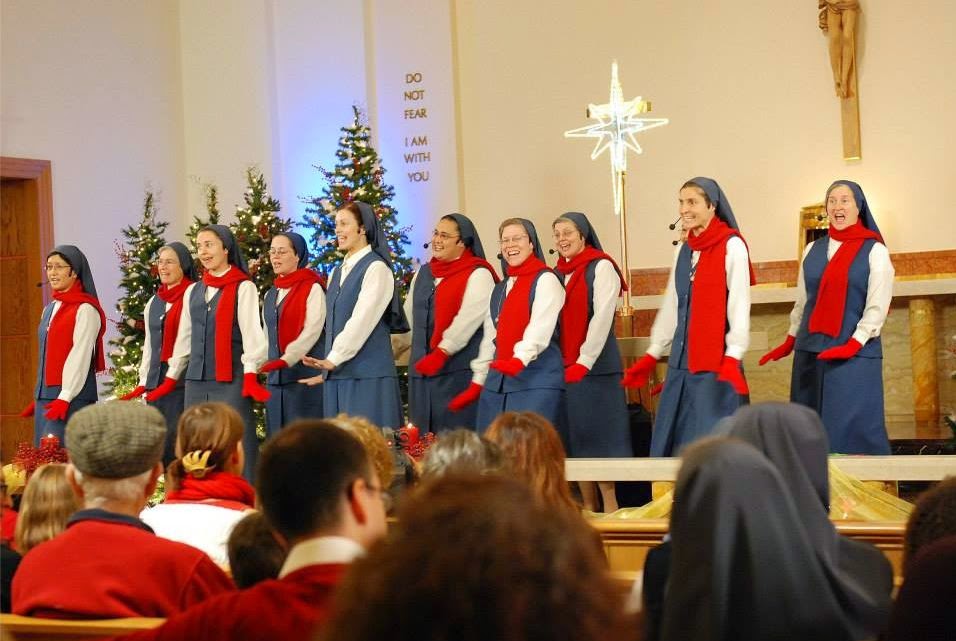
It's almost time again, folks! Here's where we'll be:
Joy to the World
Daughters of St Paul
2014 Christmas Concert
Piscataway, New Jersey
Wednesday, December 3 at 7:00 pm
Our Lady of Fatima Parish
499 New Market Road
Ticket information: Tel. 732-968-5555 |
Web: www.olfparish.org
Staten Island, New York
Thursday, December 4 at 6:00 pm
Benefit
for the Daughters of St. Paul
Staten Island Hilton Garden Inn
1100 South Avenue @ Lois Lane
Ticket price:
$125
For more
information: 718-477-2100 x 226
www.daughtersofstpaul.com/hiltonconcert
Cleveland, Ohio
Friday, December 5 at 7:00 pm
Cathedral of St. John the Evangelist
1007 Superior Avenue
For more
information: 216-696-6525 x 5510 | Email: gheislman@dioceseofcleveland.org
Ramsey, New Jersey
Sunday, December 7 at 7:00pm
*Featuring
Don Bosco Prep H.S. Boys Choir
St. Paul R. C. Church
200 Wyckoff Ave.
Ticket
information: Tel. 201-327-0976 | Web: stpaulrcchurch.org
Philadelphia, Pennsylvania
Tuesday,
December 9 at 7:00 pm
St. Katherine of Siena Church
9700 Frankford Ave.
Tel. 215-637-7548
| Web: www.skschurch.com
Marshfield, MA
Friday, December 12 at 7:00 pm
St. Ann by
the Sea Parish
591 Ocean
Street
Ticket information - Tel. 781-834-4953
Boston, Jamaica Plain, MA
*Now
3 performances *
SATURDAY, December 13 at 7:00pm
SUNDAY, December 14 at 3:00pm AND 7:00pm
Daughters of St. Paul Chapel
50 Saint Paul’s Avenue
For more information, visit our Facebook
page: facebook.com/DSPchoir

September 23, 2014
MOVIE: "THE SONG"
“The Song” is a new Christian film inspired by “The Songs of Songs” (aka “The Song of Solomon”) in the Bible. It is one of those distinctly southern/country culture films, with the two main characters being Christians themselves.
It’s a story of adultery. A story of career vs. vocation, and spouses who are physically separated growing apart. It reminds me of the Christian film “October Baby,” in that the first half is poor quality and the second half gets real.
It’s a story of love, marriage and the meaning of life.
The first half is barely one-dimensional. We don’t get to know the man (Jed--Alan Powell) and woman (Rose--Ali Faulkner) who get married and whom we are supposed to care about for the rest of the film. But we do get to know them later through their sins, in a sense. However, there is nothing distinctive about this man and this woman. Nothing unique, original. No defects, dreams, quirks, secrets, experiences, events, histories or desires that are not totally generalized as Everyman and Everywoman. The plot has a few surprises, but there remains very little subtext throughout.
The film is interspersed with very effective voiceover of actual passages (recited by the husband) from the Song of Songs interwoven with Ecclesiastes. They are recited with aplomb in a semi-contemplative, poetic way.
This is a man’s film, a man’s perspective, and not only because the main character is male. There are definite shadows of “women are either idealized virgins-brides-wives-mothers or pure temptresses.” No nuance, nothing in between. The writer-director, Richard Ramsey, did not seem to be able to imagine a woman’s inner life too deeply. The two women actresses do fabulously with what he gave them (and Alan Powell is an accomplished actor/musician as well). But the film does illustrate for men WHAT MEN REALLY WANT. I’m sure this film could touch the hearts of many guys.
The film is aptly named, because there is a lot of music throughout. Mumford & Sons style tunes. Whole songs and snatches of songs. When one song ends, another one begins almost immediately. There seems to be more lyrics than dialogue. But, of course, that is also a way to move the story forward and convey sentiment. Since Jed is a performer and lives in a big way through his music, spending much of his time on stage, we are joining him in his element.
The fighting seems to be more real than the loving between Jed and Rose. Perhaps because the romantic scenes were so saccharine while the clashes were so volatile and even mean (irresistible for actors)! And Jed had some “excellent” excuses for his behavior. Rose also had some great reasonings and justifications on her side. The marital difficulties felt so authentic—too bad the chemistry wasn’t also as palpable.
Am I being too critical of this film? I think not. Gotta call ‘em like I see ‘em. Would I recommend a look-see? Yes. I think “The Song” challenges us to fill in our own blanks: What is the authority of Scripture in our lives? What are our ambitions? What are our duties to God and the ones we love? Where will we truly find fulfillment?
OTHER STUFF:
--We were taught in film school that you need to make characters distinct. The more particular you make a character, the more universal they become. There is something in everyone’s specific experiences that others can relate to even if it’s not the exact same circumstances. By trying to create a big, general archetype instead of a real, individual human being, nobody can relate.
--“The temptress” is even dressed like Delilah during one of her seduction sessions. I almost expected an asp to wheedle its way into the frame. The temptress seemed more down-to-earth than the doe-eyed wife who never quite advances from being Daddy’s little girl. In fact, Daddy lives with them, and when Jed is unfaithful to Rose, he has nightmares about Daddy coming after him. It’s like Rose is not fully grown. She is bypassed by the men. She is daughter-turned-conservatorship-wife and Jed is answerable man-to-man to his father-in-law, not his wife. At least at first.
--The camera work is rather unimaginative OR it could simply be budget constraints.
--I think there were some plot-point scenes cut out because I could detect their fragments?
--Um, do they not have laws about roughing up women in public in Kentucky? (Jed does it twice.)
--We didn’t need to see Jed’s Dad at the beginning. It was very unclear that we were in the past and who all the characters were. It seems flashbacks might have worked better, or other devices to show Jed’s musical superstar Dad overshadowing Jed.
September 22, 2014

September 16, 2014
MY BOOK BUCKET CHALLENGE
(In chronological order as to when they influenced me. As much as I love philosophy, no philosophy book--except JP2's--ever changed my life. What is philosophy good for then? It keeps me Catholic.)
1AllTheBooksiReadAsAKid
2FieldGuideToEasternBirds by Roger Tory Peterson
3Bible 4ImitationOfChrist 5AnythingByAlberione 6iBelieveinLove by D'Elbee 7PowerinPraise by Carruthers 8TheologyOftheBody by JP2 9AnythingByJP2 10TheWetEngine by Doyle #BookBucketChallenge


September 6, 2014
MOVIES: "THE GIVER"


"The Giver" is yet another young adult dystopian novel
turned into a movie, but it actually preceded many of the others. This engaging,
perfect-for-our-times narrative by Lois Lowry was published in 1993, and is
required reading in many schools. There is controversy surrounding the content,
but for the life of me, I can't figure out what the problem is. (I've put a
shout out several times on social media and get very weak answers.) I have not
read the book (I view, not read), but LOVE the movie on the movie's own merits.
The fact that good people are wishy-washy about this movie
is very scary to me. Do we no longer know how to read parables and allegories?
Do we no longer grasp basic theological and philosophical principles to make
good judgments about literature and the visual arts?
NOT JUST ANOTHER DYSTOPIA
"The Giver" is closely aligned to other science fiction
"cautionary tales" of the strain of "Brave New World,"
"Gattaca," "A Wrinkle in Time," and "The Adjustment
Bureau," with its focus on the power of emotions and love to overcome tyrannical
control--even if the control is supposedly for the ultimate good of humanity. I
actually found "The Giver" to be closest in theme to M. Night Shyamalan's
"The Village" (an excellent, under-seen, underrated film), due to the
similar quest to wipe out violence and tragedy in society, and attempt utopia.
The film starts off, appropriately, in black and white.
Three teens are coming of age in their simplistic world where they will be
assigned their lifelong jobs based on their emerging talents. Babies are genetically
engineered and raised by "Nurturers" in nurseries. The main
character, Jonas (Brenton Thwaites), is strikingly different from his peers,
however. Sometimes he sees glimpses of color. He sees more, he sees beyond. The
governing board (led by the inimitable Meryl Streep) notices his special gifts
as well, and they read it as a positive. So much so that they assign him the
very special task of "Receiver of Memories." Only this person is
allowed to know history, allowed to know what came before this bland existence
in order to advise the board and become a wisdom figure.
The entire basis of this society is the elimination of
memory (so that war will never occur again), rules designed to keep everyone in
their place ("sameness" so that there is no competition, difference
or inequality), and dispensing of morning drugs to suppress all emotions (including
sexual "stirrings"). "Precision of language"--a kind of
political correctness--is demanded in an effort to never give offense, never be
curious, never express oneself, never be different, never know more than what
is prescribed.
A SACRAMENTAL WORLD
In his role as Receiver, Jonas begins to EXPERIENCE a
sacramental world. Things have deeper MEANINGS that can be felt and expressed
in many different ways beyond basic information and intellectualizing. He
experiences that the powerful role of EMOTIONS in our lives can be channeled
for the good (whereas the belief of his society is that they always lead to violent passions, contempt and murder).
Just like our own increasingly more callous and
uncomprehending society that treats people like things, Jonas' society gets rid
of the weak (that is, the very young and the very old) with mercy-killings
euphemistically called a "release to elsewhere." Jonas' own
"father" is a benign executioner, and Jonas excuses him because he
realizes his father does not UNDERSTAND what death means. (Just like our
society doesn't understand life and death either, human dignity, human value,
the value of the vulnerable and suffering, and our responsibility to care for
them.)
THE PRIMACY OF THE FAMILY
On one hand, the message of the film might seem to be: Rebel
against anything keeping you down! Rebel against rules and regulations!
Experience whatever you want to experience in life! But that's not it at all.
It's rather: no pain, no gain; no cross, no crown. The answer to misused
freedom is not removing freedom, but well-used freedom which will always
involve love and sacrifice. But where is love and sacrifice and human
connection and tenderness first learned? In the family, in the home.
Our family life is not controlled by constant surveillance
and outside forces (unless we count consumerism and peer pressure), but on our
own we have reduced our family life to frenetic scheduling, no family meals,
everyone blocking everyone else out through personal media devices, domestic
arts outsourced, parents too busy or too cool to parent, kids and teens running
the show, common courtesy and manners left untaught, etc.
A MAN AND A BABY
My favorite part of the entire film is the young man saving
the baby by trekking out into the wilderness with him. The baby in question
happens to be a little boy (Gabriel), which makes "The Giver"--at
least partially--a sweet buddy movie. When's the last time you saw a young man
taking on ANY kind of fatherhood role in a film (outside of a raunchy comedy
that reinforces the idea that young men being responsible is just ridiculous)?
What makes this story so apt for our age is that we ARE
living in an incredibly unnuanced, one-dimensional, diminished, reductionist, soothe-pain-and-unpleasantries-by-all-kinds-of-drug-and-drug-like-escapes
culture. No one gets hurt in Jonas' dystopian world. But is anyone really living?
Really living a human life? Or DO people get hurt? The dirty little secret it
that clandestine brutality keeps open brutality in check.
The whole film could be summed up in one word: MORE. There
is so much MORE that we can have. John
10:10.
OTHER STUFF:
--THEOLOGY OF THE BODY? Heck, yeah! The kernel of society,
love, life, happiness is the male/female relationship, the family and babies. When
the Jonas discovers the great deceit and deprivation everyone has been living,
he exposes the falsehood thus: "A 'dwelling' is not a home. Our 'parents'
are not really our parents." Actually, this is an AWESOME Theology of the
Body introduction movie.
--There are Judaeo-Christian overtones with the concept of
"forbidden knowledge"; "Jonas," the reluctant prophet; and
even an apple prominently featured.
--Katie Holmes does a great job as Jonas's robot-like
maternal unit (and Department of Justice Minister), striving to keep Jonas in
line. Jeff Bridges is "The Giver" to Jonas' "Receiver" of
Memories.
--Jonas' girlfriend, Fiona, stops taking her dulling meds
and tries some "precision of language" of her own: "I'm not
UNCOMFORTABLE, I'm AFRAID." (I went to a bio-ethics seminar once and the
speaker promoting human cloning tried to quell the audience's misgivings with:
"What is it about 'nuclear cell transfer' that makes you uncomfortable?")
--The baby who plays Gabriel has the "knowingest" look on his face at all moments.
--The trailers are lame. Don't judge the movie by 'em.
--The baby who plays Gabriel has the "knowingest" look on his face at all moments.
--The trailers are lame. Don't judge the movie by 'em.
--The Giver's speech about humanity's ability to live love
and peace reminded me of John Paul II's "peace is possible!" speech,
and his great faith in the POSSIBILITY that we can find and live another way.
--"If you don't feel pain, you won't feel anything
else, either." --"Ordinary People"
September 5, 2014
August 17, 2014
HELPING THE NUNS JUST GOT EASIER!
YOU DID IT!!! THANK YOU SO MUCH!!!
THE RELEASE DATE OF
"MEDIA APOSTLE:
IS JANUARY 25, 2015!
DVD WILL BE AVAILABLE & IT WILL BE ON BROADCAST STATIONS!
THE RELEASE DATE OF
"MEDIA APOSTLE:
THE FATHER JAMES ALBERIONE STORY"
IS JANUARY 25, 2015!DVD WILL BE AVAILABLE & IT WILL BE ON BROADCAST STATIONS!
MATCHING GRANT! All donations now through August 20, 2014 midnight (100th Anniversary of the Pauline Family) will be DOUBLED! Donate securely at www.MediaApostle.com. Watch thermometer progress at www.tinyurl.com/FinishFilm

August 11, 2014
MOVIES: "CALVARY"

DON'T WATCH THE TRAILER UNLESS YOU MUST. IT GIVES AWAY TOO MUCH.
The new Irish film, "Calvary," is a fierce
expedition into the repercussions and present climate of
post-clergy-sex-abuse-scandal Ireland. It's an unblinking, fictitious story
that's an apt vehicle not so much to wonder "how?" and "what
went so terribly wrong?" as it is to gauge people's reactions.
"Calvary" sports the simplest, boldest, shortest
Act One I have ever seen in a movie. It's over and done with in three minutes.
Bravo. All we see is a close-up of a priest (a fabulously hoary-red Brendan
Gleeson, our main character) in a confessional. All we hear is the voice of an
unseen adult male penitent telling Father James that he was raped by a priest
repeatedly when he was seven. And now he is going to kill Father by the end of
the week. Why? Not because Father's a bad priest, but because he's a good
priest. (The priest that abused him is dead.) What a premise.
Killing a good priest to pay for the sins of his comrades is
a roomy set-up to take the story anywhere. And that's exactly where it goes. We
enter the lives of the villagers who live within the bounds of Fr. James'
parish but are mostly estranged from the Church. Father? They tolerate him well
enough, and some even admire him, but the fact is that he represents the Church
that aided and abetted heinous crimes against children. For which there is no
excuse, and perhaps no forgiveness?
The coming to light of the egregious clandestine sex abuse
was, for some in the village, the revealing of a great deception, but others
knew what was going on and were powerless to do anything about it.
Father is a great guy. A pillar. A down-to-earth human being
who is not afraid to enter into others' pain. But his wayward flock have no
problem jostling him, telling him off, challenging him, disparaging him or
attempting to demoralize him with their deep, deep cynicism. Father's realistic
optimism and hope has its limits, too. But Father is not ruffled by the death
threats. He doesn't change anything about his daily routine, something we would
expect from someone at peace with God, themselves and the world.
The flow of "Calvary" is held together more by one
random philosophical musing after another (embedded in various characters) rather
than plot points, and we almost forget that Father has a bullseye on his back,
but it's all so terribly intriguing, and what's actually being done here is
hardcore theology. Irish theology, but theology. Very refreshing.
"Calvary" goes after the toughest life and death questions it can, but
not the endless paradoxical conundrums that only neophytes find brilliant and engaging.
I think director John Michael McDonagh really wants to know. He picks apart
cliche after cliche and flirts with atheism. Is God a true character in
"Calvary"? No. He only seems to be known through a second party: His
priest.
In an unspoken, yet just below the surface way, the men in
"Calvary" seem disgusted with God the Father (as many men do!). You
can almost hear them phrasing: "Why should I be good when You're
not?" "You're my model of fatherhood?" "You let Your Son
die without intervening, no wonder you do nothing to intervene on earth." "Your
priests are pathetic _____'s." This is a man's film. There are three
women in it (two are minor characters). "Calvary" is the men circling
the wagons, or at least getting together in a huddle after disaster to expose
their deepest sentiments about the event. And most of these sentiments are very
dark. Father, however, is the lone dissenter from utter and complete darkness.
Everyone calls Father "Father." Even if they do so
in a sardonic way, it always seems to be an acknowledgment of his true
identity.
Does this film preach at us? No. Is it an angry film? No. Is
it a film about justice? Yes. Is it a film about forgiveness? Yes. Is it a revenge fantasy? Maybe. Will we
laugh a bit through our tears? Yes. Is the film "fair" to the Church
and the priesthood? Yes. Can we have too many quality films on this subject? No.
It would be criminal not to make films. We are just beginning to process the
horror. As Cardinal Timothy Dolan said, we shouldn't
stop talking about this, partly to try to ensure that it never happens again.
OTHER STUFF:
--This is how you make a priest a main character. And a real
character.
--This is a very well-made film. An OPEN story is when we
know things the main character doesn't. A CLOSED story is when we are gaining
information the same time as the main character. I'm not sure how to classify
"Calvary" because FATHER JAMES KNOWS WHO THREATENED TO
KILL HIM, AND WE, THE AUDIENCE, DON'T! Brilliant.
--The cinematography is pleasant, but often overly
self-conscious--more concerned about setting up gorgeous Hopper-esque mise-en-scenes
than telling us the story. There are also comically (on purpose?) heavy-handed
framings of violence (meat and guns) which bespeak one of many semi-developed themes of
"Calvary": "sex and violence."
--Some wonderful, wonderful lines: "The limits of God's
mercy have not been set."
--If the two priests we meet in "Calvary" are
treated with absolutely no deference, it makes you wonder if that's because
deference is what enabled the scandal.
--A few instances of the Irish demanding that life be a play
filled with poetry.
--The soundtrack is spot-on and "invisible." You
will not even remember it.
--Father James is a (good) "sign of contradiction" to everyone, including, sometimes himself. Calvary indeed.
--Mr. McDonagh does not come across as a Church hater. He's not going to give up that easily after 2000 years of Christianity in Ireland.
--Father James is a (good) "sign of contradiction" to everyone, including, sometimes himself. Calvary indeed.
--Mr. McDonagh does not come across as a Church hater. He's not going to give up that easily after 2000 years of Christianity in Ireland.
Subscribe to:
Posts (Atom)