February 29, 2012


February 28, 2012
MOVIES: "THE VOW"

“The Vow” was a MUCH better movie than I thought it would be.
It has the feel of a Nicholas Sparks tale, but even better.
“The Vow” is based on the true story of a wife who is in a
car accident, has some of her memory (namely the time frame of meeting her
husband and their subsequent marriage and life together) erased. Will she be
able to fall in love all over again with the man she married? The husband (Channing Tatum) is the main character, who narrates.
“The Vow” (there’s also a book by the same name) is based on
a true story of a Christian couple to whom this very thing happened. The book
keeps all the Christian references while the movie expunges every last one. The
actual couple themselves are “at peace” with how the movie turned out because
they know it will have wider appeal that way. In one way, without any religion,
the film shows that marriage is a natural institution, that human beings know
that the vows we make to each other are sacred things.
This extremely unique situation has a further twist to it:
Paige (the fine actress, Rachel McAdams) already had a sea change in her life
before the accident. She was a wealthy, preppy, “left brain” gal engaged to a wealthy,
preppy, left brain guy. But something caused her to reinvent herself. She cut
herself off from her family, quit law school, moved downtown, went to the Art
Institute and became a successful sculptor. In her new “right brain” life, she
met a fellow artistic type, Leo (the fine actor, Channing Tatum) and married
him.
After the accident, Paige is willing to give life with Leo a
go, mainly because the doctor told her that carrying out her “usual routine”
could help her get her memory back (the last thing she remembers is law school
and being engaged to Jeremy). Leo, of course, is suffering tremendously because
of this strange estrangement. He is madly in love with Paige—Paige knows it and
feels bad, but she not only doesn’t remember Leo, she doesn’t remember anything
about her re-invented self. She feels much more comfortable back at her parents’
home and with her old friends…including Jeremy.
In “The Vow,” the dialogue is fresh and unexpected. There are
many ways to say “I love you” (the sign of a well-told love story), feelings are
not equated with love, love is not equated with sex, the whole person is taken
into account in a highly civilized manner, nothing is cutesy or trite. The exposition
is hidden and well seeded throughout the film, with lots of “little touches,”
e.g., when Paige awakens from her coma she thinks her hair is “weird,” which
tells us that not only does she not recognize Leo, she doesn’t recognize
herself.
The emotional sleaze factor (“women’s porn”) is low because
of the non-cloying camerawork. It doesn’t linger on long smooches or even the
occasional semi-nude body. And yet the film is totally romantic, mostly because
Channing Tatum—in his “manly man” way—expresses profound and tender affection
for Paige. (I still can’t decide if Channing Tatum--as in his other movies--is:
1. A genius at pretending to emote the way women wish men would emote, 2. Showing
us what men really do feel but don’t like to or can’t seem to reveal, 3.
Showing us what only some men feel. I think I need some guys to weigh in on
this.)
What would you do in this situation? My first thought when I
first heard the plot of this movie was: Um, wouldn’t extenuating circumstances
release the wife from her vow? Evidently this woman did not believe so! (And
the Christian wife in reality didn’t feel God/the Bible released her from her
vow just because of a brain injury!)
There is much voiceover (Leo’s) in the film (Channing Tatum
does a superb job with this, too) trying to explain (fallaciously) that we ARE
our memories, so what happens to our identity when they go away (somewhat the
same argument for Alzheimer’s patients)? Theology of the BODY, baby. Doesn’t
matter if we are conscious, self-conscious, unconscious, subconscious, asleep,
dreaming, daydreaming, wishing, forgetting, in a coma, catnapping, zoning out,
spacing out…we still are who we are.
There is another theme about the “impact of moments” which
gets so obfuscated that it sounded like a plot point from “Inception.” But no
matter. This is a lovely love story with pretty much healthy, down-to-earth, realistic, playful, mature, reverent male-female
relationships, with even an emphasis on needing time alone, unattached, to be
ourselves and find ourselves before we can truly make a gift of ourselves to
another.
OTHER STUFF:
--Filmed in Chicago. On cloudy days. Which are very typical
of Chicago. The Music Box! The “L”! The Bean! The Art Institute! The Chicago
River!
--In reality, the wife NEVER got that part of her memory
back!
--“The Mneumonic Café” was a bit over the top.
--Very genuine relationship struggles. Good.
--Affairs are a very bad thing. Good.
--“The Vow” has a simple, plain (but not anti-climactic)
ending. Like life. Good.
--I think this film says very eloquently in the dialogue
what many people feel and live in their love relationships, but don’t have the
words for. BJP2G said “not enough is made of ordinary love.”
--One of the screenwriters, Jason Katims, was a writer for “Friday
Night Lights” which supposedly had a strong, loving, realistic married couple
in the show. Another writer, Abby Kohn, is known for the films “Never Been
Kissed” and “He’s Just Not That Into You,” both of which have some great
portrayals of true love.
--The director, Michael Sucsy, is a total “got-out-of-the-way-director.”
He’s invisible. I LOVE that. The only other thing he seems to be really known
for is “Grey Gardens” with Jessica Lange and Drew Barrymore.
--A young dude sold me my movie ticket.
Young dude: “Are you a……..?”
Me: “Nun.”
Young dude: “That’s tight.”
Me: “Yeah, I write the movie reviews for the Catholic paper in Chicago.”
Young dude: “That’s tight. You’re gonna see a lot of Christian parallels in this movie.”
Me: “That’s tight.” [No, actually, I told him how the real couple WERE Christians. A fact he didn’t know.]
Young dude: “Are you a……..?”
Me: “Nun.”
Young dude: “That’s tight.”
Me: “Yeah, I write the movie reviews for the Catholic paper in Chicago.”
Young dude: “That’s tight. You’re gonna see a lot of Christian parallels in this movie.”
Me: “That’s tight.” [No, actually, I told him how the real couple WERE Christians. A fact he didn’t know.]
--People often ask me how they (or I, with my vow of
chastity) can keep “pure” while watching romantic movies or steamy scenes in
movies.
#1. “Know Thyself.” Know what is an occasion of sin for you in particular, and avoid those kind of movies or look away at the “steamy” parts or parts that are particularly troublesome for you. Everyone has different sensibilities and thresholds. But we have to have a well-informed, well-formed, delicate (not scrupulous or lax) consciences and be very, very honest with ourselves.
#2. Much of visual media is voyeuristic--it’s just the nature of the beast, and depending on the intentions of the filmmakers and the cinematography, we will be either MORE or LESS put in the position of the voyeur. Even if not sexual in nature, we may be pulled in close to a very realistic portrayal of something else generally personal or private (e.g., suffering, pain, embarrassment, relationships, conversations, failure, etc.) Again, know yourself, but also watch the movements of your mind and heart. Am I gloating over something evil? Siding with the bad guy? Getting some kind of twisted pleasure from another’s misfortune? Enjoying something lewd and crude? Lowering my personal standards and morals with each crass movie I see? Always humanize the characters on the screen in your mind and feel toward them as you should feel toward real people. All media is virtual reality, and virtual reality is real: “real in its appearance and real in its effects.”
#1. “Know Thyself.” Know what is an occasion of sin for you in particular, and avoid those kind of movies or look away at the “steamy” parts or parts that are particularly troublesome for you. Everyone has different sensibilities and thresholds. But we have to have a well-informed, well-formed, delicate (not scrupulous or lax) consciences and be very, very honest with ourselves.
#2. Much of visual media is voyeuristic--it’s just the nature of the beast, and depending on the intentions of the filmmakers and the cinematography, we will be either MORE or LESS put in the position of the voyeur. Even if not sexual in nature, we may be pulled in close to a very realistic portrayal of something else generally personal or private (e.g., suffering, pain, embarrassment, relationships, conversations, failure, etc.) Again, know yourself, but also watch the movements of your mind and heart. Am I gloating over something evil? Siding with the bad guy? Getting some kind of twisted pleasure from another’s misfortune? Enjoying something lewd and crude? Lowering my personal standards and morals with each crass movie I see? Always humanize the characters on the screen in your mind and feel toward them as you should feel toward real people. All media is virtual reality, and virtual reality is real: “real in its appearance and real in its effects.”
#3. Viewing a film is supposed to be an exercise where we
put ourselves in the position of the characters (especially the main character)
and vicariously go through an experience with them. However, if this experience
is going to cause us to sin now or later, we need to shut down physically and
emotionally for a time, look away, walk out of the theater, fast forward, shut
off the device we’re watching the film on, etc. Therefore: I don’t gaze into
Channing Tatum’s eyes for long stints with Rachel McAdams, or ogle his ripped
pecs every time he takes his shirt off (which is quite often). It kinda hasta do with human dignity, too.
Channing is getting paid to sell emotions, to tantalize, to provoke reactions,
to be looked at. He is very willing to do this. But is it fully in keeping with
his human dignity for millions of female strangers to stare at his body and perhaps even lust after him?
Just because he’s willing and getting paid and I ostensibly paid to see him,
does that mean I get to just glue my eyes to his body? No. Repecting human
dignity means affording people their dignity even when they themselves don’t
care about it. And this must also be a tough call for actors when it seems
appropriate to the part, or just part of the job, or they feel very comfortable
in their own skin, etc.
#4. Pray. Media is spiritual, powerful, influential,
ubiquitous. Pray for enlightenment, strength, wisdom, discernment and for ill
effects not to harm you as you use media. Ask God to let you see only things
that will help you or help you help others (even if some might be somewhat unsavory),
and to know how to turn them around for your good and the good of others. Ask
to be the fragrance of Christ in a media world. Pray to engage the media and
other media creators/users with the Gospel. Pray for the honesty to use media
in the best way possible, to not waste time, to not sin in your use of media.
Go to Confession when you use media improperly: specifically to sin, to waste
time, to escape from real duties or people, (and some of the uses mentioned
above), etc.


February 27, 2012
(MOTHER) DOLORES HART ON THE RED CARPET AT THE OSCARS

She is a total rascal. And I've heard this LOUD whistle up close and personal.
I think she was totally in her glory being back in Hollywood. She is a consummate actor.
The short doc on her life was nominated for an Oscar: "God Is the Bigger Elvis." Didn't win.
VIDEO OF MOTHER "MUGGING" BEHIND MAYA RUDOLPH:

Dolores Hart and Elvis (she gave him his first on-screen kiss in "Loving You"
and also starred with him in "King Creole").
and also starred with him in "King Creole").
February 25, 2012
BIOLOGY OF THE THEOLOGY OF BODY--VICKI THORN, RN
For larger type, click on text.


WANT MORE VICKI THORN? ORDER HER DVDs OR CDs:
February 14, 2012

MOVIES: "THE ARTIST"

Why is “The Artist” being showered with so many
international awards (and most likely a few Oscars)? It’s all about BRINGING
BACK THE MOVIE MAGIC. Like “Hugo,” “The Artist” is a film about the craft of
movie-making (it was a good year for such films). Whereas “Hugo” focuses on
special effects, “The Artist” focuses on acting. But more than acting. The
black and white “The Artist” focuses on VISUAL STORYTELLING which is precisely
what film is SUPPOSED to be. Anyone who has gone to film school will appreciate
the forceful message here, summed up by the last word of the film: “ACTION!”

Filmmaking true to its pedigree tells the story VISUALLY.
Lazy filmmaking (think “visual audiobooks”) tells the story through words,
words, words (and plenty of voiceover). “The Artist” MUST tell the story
visually, you see, because it’s a SILENT FILM. Say what? You heard me. And there
are those black backgrounds with some white curly dialogue every so
often (like “The Perils of Pauline” that people of a certain age will remember
seeing on Saturday mornings). But these words were not even needed. We could
have utterly followed everything without them. Brilliant.

George Valentin (looking like the real McCoy, a manly actor’s
actor, Jean Dujardin) is a middle-aged silent film actor. A chance meeting with
aspiring young actress Peppy Miller (Berenice Bejo) begins the saga of her
“talkie” career on the rise and George’s “silent” stardom waning—also due to
his resistance to a changing world. In spite of their age difference and
opposite fortunes, a love story develops. For me, this was a hearkening to
those who can’t accept that we now live partially in a
computer/digital/online/virtual world today. Companies like Blockbuster persisted
in deep denial until it was almost too late.
Dujardin, who is up for a “Best Actor” Academy Award, is
alternately melodramatic (as the silent movie star), brooding, forgetful of the
camera, and a camera magnet. He is able to gaze prolongedly into and in front
of the camera, as well as get us to gaze prolongedly at him. He is a total
natural. Totally comfortable in all kinds of limelight. A true creature of the
screen.
Although the story is too light to ever be wrenching
(accompanied by such a delightful, old-timey, bouncy, Depression-era, “silver
lining,” “sunny side of the street,” orchestral soundtrack), its tender moments
are truly that. Since much of “The Artist” depicts films within a film, the
takeaway seems to be that life is a film. Life is a SILENT film that is much more
about our actions than our words. I would say life is a drama, a liturgy, a
dramaturgy with a Paschal pattern. Like a star, we’re born, we grow, we shine,
we fade, we die. And then we rise again.
I left the theater DANCING. You will, too.
OTHER STUFF:
--Alternate title for “The Artist”: “A Man and His Dog.”
--Is the Jack Russell (Ma calls them “those Jack Daniels
dogs”) up for a doggie Oscar? He should be! He was in almost every scene. So
cute when he buries his head….
--Peppy really is peppy. Flapper girl.
--George Valentin. Rudolph Valentino.
 |
| OK, my stink eye is not as good as this little fella's. |
--Three young ladies in my theater did NOT hear the Lorax
telling them to shush it at the commencement of the film. So I told
them to shush it during the Previews because I could tell we were going to have
a problem. I wanted to hear every word of the Previews for my $11.50 (Chicago
Loop cinema going ain’t cheap). And then, wouldntcha know it, it turns out to
be a silent film, so I couldn’t act like I couldn’t hear the words when they
kept up their tittering. But, dang it, movies are an (expensive) EXPERIENCE and
these chicks were ruining the kick-posterior, lilting, music-only soundtrack. I
leaned forward, and, in the glow of the glorious black and white, gave them my
best stink eye. They caught it and put a sock in it for a few scenes. (It’s
amazing the courage and strength one garners from being a consistent female
opt-out at the airport cancer machines, and doing the pat-down in public—in
order to set a good example.) Halfway through the film, the three “talkies”
exited. Philistines. (But I still love them, of course--and all philistines--in
Christ.)
--The Hollywood community understands and portrays well
their particular brand of artistic heartbreak in the Hollywoodland of broken
dreams…. Reminded me of “Mulholland Drive” under this aspect. (NB: I otherwise
have huge problems with “Mulholland Drive.”)
--I am hoping “The Artist” might trigger a 20’s fashion surge
(kinda like we had in the 70’s). I love 20’s fashions (for both guys and gals).


--Seriously? They had a “SCREENWRITER” chair on the sets
back then? Sigh. “How are the mighty fallen.”
--Minor flaws: I felt like the film within a film in the
beginning, to truly look like a silent film, should have been speeded up. The
film hit its stride at the multiple “takes” when George first acts with Peppy.
From there it was smooth going. Some shades of “Singin’ in the Rain” plot
points….
--Dujardin totally nails the dapper peacock primping,
preening and “mugging” of the times.
--“Tree of Life” is up against two FEEL REALLY GOOD MOVIES
for Best Pic: “The Descendants” and “The Artist.”
--So I slept on it. My fears were NOT allayed. This movie is
a pleasurable “in the moment” adventure, but has no sticking power. Zut alors!*
Ultimately forgettable. Except for that balmy, tripping the light
fantastic SOUNDTRACK that I would love
to hear as I walk down the street every day…. :] Even the ominous parts are only quasi-ominous.
____________
Ugh. Even my French is “antiquated.”
Ugh. Even my French is “antiquated.”
February 4, 2012


February 3, 2012
MOVIES: "EXTREMELY LOUD AND INCREDIBLY CLOSE"

“Extremely Loud and Incredibly Close” is the story of a boy who loses his father in the Twin Towers on 9/11. Oskar Schell (wunderkind Thomas Horn) seems to have Asperger’s syndrome (Oskar comments that tests were “inconclusive”), and his dad (Tom Hanks) was the only one who really understood his brainy but socially awkward and phobia-ridden son. Oskar’s relationship with his mother (Sandra Bullock) is distant and strained.
Oskar, his mother and his paternal grandmother (with whom Oskar is also close because she communicates on his level) live right in Manhattan. “Extremely Loud” reconstructs what Oskar dubs “the worst day.” We are taken through the exquisite pain of what families must have endured during and after their terrible losses. To “make sense” of the pain (Oskar is all about science, facts and logic) and to be able to hold on to and feel close to his father, Oskar sets out on a mission to find the lock that goes with a mysterious key found in his father’s closet.
Oskar’s quest takes him all over New York City to meet many, many people, and in the process he must overcome his many, many fears (exacerbated by the trauma of 9/11). He has a fiercely determined and obsessive will, and his general inability to empathize/sympathize with others makes him sometimes verbally and otherwise abusive, especially toward his mother.
It’s pretty interesting and enlightening to see the world from this geeky kid’s perspective. There are more and more young people like Oskar, and we will be seeing more and more films incorporating these characters. However, the total improbability of a guileless young boy journeying around NYC alone (although the highly improbable reasons for his safety are later explained to us, and the fact that at one point an older gentleman [Max von Sydow] accompanies him on many of these treks) makes the heart of this tale feel exceedingly unreal.
Although there is a delicate, moving soundtrack, and the dialogue and acting is meticulously executed by the finest in the business, there is just so much artifice to the whole project that I never once lost myself in the story or forgot that “these are actors” and “this is a film”—a well-simulated tale, but ultimately contrived. It hits all the right notes, tropes and hackneyed themes, but the only originality here is getting into a boy like Oskar’s mindset when faced with a horrible tragedy (Oskar gives abundant voiceover to the slow-paced 129 minute film, but it fits). The clichés are attacked head on: “Everyone has a story to tell.” “Everyone has suffered something.”
There were many sniffles in my theater, but I just couldn’t. It didn’t feel as though 9/11 was being exploited, and I didn’t feel emotionally manipulated: it was more like the product I was watching was pitch-perfect, Purell-sanitized with very few surprises or light moments although it tried mightily to aim for both. We were taught in film school that you’re allowed one perfect coincidence in a film, usually in Act One, but ELIC has quite a few. I just didn’t buy it.
The value of ELIC? To hear the distinct voice of an Asperger’s kid who moves from headstrong to heartstrong. Life is a bunch of little moments. To re-live 9/11. To examine various archetypal father-son relationships (solid and weak). To look death squarely in the face and know that “love is stronger than death,” even for a little boy who doesn’t believe in miracles.
OTHER STUFF:
--Plot points a bit convoluted.
--Another film with PRECIOUS little media technology shown being used (even though film IS set back in ancient 2001). People talk to each other, write longhand letters, hug, draw, scrapbook, have deep conversations, play old-fashioned games, admire and use artifacts from the past (note old camera, old film projector). Today’s movies are becoming refuges for depicting hyper-tech-free living, no-tech zones.
--The title was never used in the film (that I caught, anyway) but totally appropriate since Oskar does not like loud noises (one of his quirks).
--Like the “Twilight” series, the folks in “ELIC” have lotsa, lotsa time on their hands. They don’t cook, eat, shop, go to the bathroom, do dishes, make coffee, take showers, do homework, clean, etc. Hey, even Lisbeth Salander goes to the grocery store for supplies.
--Thomas Horn (discovered when he won during Kids Week on Jeopardy) is just totally precocious, like so many of the incredible crop of child actors today.
--Oskar has an Oscar moment when he’s explaining in a deluge of a monologue to his grandmother’s mute elderly gentleman “renter” all that he has endured since 9/11…. Also, great scene of his rage at the end, when Mom tries to calm him down.
--Oskar is very hard on himself and demanding of others. He feels things so intensely, not just external stimuli, but emotions, too.
--Mom: “I’ll never fall in love again for the first time.”
--Oskar comes to the conclusion that: “People are not like numbers. They’re like letters and letters make stories and stories want to be told.” Nice.
--“Don’t stop looking.” Great advice, that.
January 29, 2012
BEST THEOLOGY OF THE BODY POETRY SLAM EVER
Not that we have unreasonable expectations or too-high standards, but we gotta do this as men and women of God....
January 21, 2012
MOVIES: "THE DESCENDANTS"

I came to bury Caesar, not to praise him, and wound up
praising him. I had my skewers ready and planned to make shishkabob out of this
film. But I cannot. Why was I all set to hate on this film? I thought it was
Just Another Sad Tale of a Dysfunctional Family Where Dad Is Once Again
Emasculated And For That We’re Going To Give It An Oscar. I thought the title
was super-lame as well. It sounded like: Just Couldn’t Think of Another Word For
“Family,” So Used Thesarus.com And Chose The First One. That’s not true either.
The title is totally appropriate.
Since the trailer already gave away a key revealing
plot-point (bad trailer! bad trailer!)--well, actually it gave away the “inciting
incident” that kicks off the action—so will I. “The Descendants” is about a
cuckolded husband, Matt King (George Clooney). It’s ALL about that. Except his wife
is in a coma when he finds out. My fellow-screenwriting buddy insists that
there is no arc for Matt, but I think there is. (Writer/director Alexander
Payne does not have huge arcs for his characters, much like life. They tend to
budge just a little bit.) Clooney’s character must choose how he will now FEEL
about his wife (he can’t DEAL with her), and how he will DEAL with her lover.
It’s a story of the choices surrounding FORGIVENESS. Who will we forgive? When?
How? Why?
It’s clear that Matt was a neglectful husband and father,
having been married to his work as a real estate lawyer. He seems to have a
closer relationship with his rebellious teenage daughter, Alexandra (the
amazing Shailene Woodley) than his precocious ten-year-old daughter, Scottie
(the ever-so-natural Amara Miller), which seems to indicate that his distancing
was a gradual thing. But his wife’s accident (that induced the coma) woke him
up to his sorry state of affairs (pun intended) and he is doing his darndest to
be a good parent now. However, dear old Dad vacillates between being a wuss AND
sticking up for his affronted manhood (which includes appropriating his
paternal authority), in many different ways.
This movie is incredibly tender (amongst all the brattiness and
foul profanity). It is a real THEOLOGY OF THE BODY movie (with reservations) in
more ways than one. First of all, Matt’s wife, Elizabeth, is in a coma for the
entire movie—lying there in her hospital bed. And everyone TALKS to her because
it’s HER and EVERYONE knows that. Elizabeth IS her body, her body IS Elizabeth—right
till one of the closing shots (don’t wanna spoil).
Marriage is SACRED in “The Descendants.” To be unfaithful is
a terrible, terrible thing. (The teenage daughter gets this in a big way, too.)
However, one might argue that “love” is treated as something more to do with
feelings. For example, it’s very important to the characters if someone REALLY “loves”
someone else (whether or not they’re having a fling with them). But love and
marriage are more than these deep-seated, je
ne sais quoi feelings. What if one REALLY, REALLY “loved” MORE than one person?
Should marriage then be “open”? What about polyamory? Polygamy? And yet, since
we—particularly in the West—have adopted the “romantic love” version of marriage
for centuries now, the question of choosing one person based on attraction/admiration
and how that plays out is a very legitimate concern. Thornton Wilder’s play “Our
Town,” and BJP2G’s “Love and Responsibility” comes in very handy here!
Matt is unselfish enough to want to follow what he believes
Elizabeth “would have wanted.” BUT what if the one you love wants things that
aren’t right?
Smarmy teens that know more than the parents? Check! But Dad
engages richly with his teen daughter who really does love her Dad. Cussing
teens (and kids)? Check! But I’m afraid that’s the reality in many, many
families today.
Not a movie for teens, methinks. The message is: The teens
are in control. You will get what you want (from your parents) in the end. We
are living in post-parental-authority times. And not only that. The CLEAR
message is: You can be as wild as you want as a teenager. You’re SUPPOSED to be
bad. Do anything you want. Drinking, drugs (not too many hints at teen sex--almost avoiding?). Nothing
bad will happen to you. You will “outgrow” it unscathed. (Bad things only
happen to parents and adults!) Once again, Hollywood chants its mantra: NO CONSEQUENCES.
Very interesting scene when family is gathered in a hotel
room and Scottie wants to watch the adult channel. She begins describing how
her same-age girlfriend watches porn all the time in the basement. With boys
over. Before Matt can take charge, Alexandra lays into Scottie and handles the
situation. This scene is horrifying, and in some ways treated lightly, but
there’s also a sharp point being made. No spiritual arguments are made, just an
extremely crude “why porn is bad” diatribe.
I have problems with virtually naked teenage girls in barely-there
string bikinis in films. I know that’s Hawaii (see also “Soul Surfer”), but
there’s a huge diff between walking by (or even ogling) half-naked girls at a
beach setting (still uncomfortable with THAT) and prolonged, voyeuristic gazing
at a larger-than-life screen. True, these gals are RAIL THIN (that’s ANOTHER
issue), but what makes it sooo creepy is how young they are. Like, hey,
filmmaker, what’s your point here? (Would also like guys to weigh in here, please…??)
However, among my various reservations about this film,
everyone is treated as a full-blown PERSON. No one is one-dimensional. No one
is just a problem or an obstacle or a story device or a cheap laugh. Even the
children and teens. Even side characters with one line (e.g., teenage kid who
expresses his heartfelt compassion for Matt at a gathering). Tremendous human dignity
here.
I completely forgot who the director was till the credits,
and I see ALEXANDER PAYNE (UCLA grad, I might add, my screenwriting alma
mater). He did “Election,” “About Schmidt,” “Sideways.” I had been thinking: “Who the heck is doing
all these unblinking-but-not-uncomfortable, exact, exact, precise, precise,
impeccable scenes?” And I just broke out in this big smile because ALEXANDER
PAYNE HAS ARRIVED! He has a much brighter view of humanity now! But he has
retained all his dark humor and distinct style. Maybe he was “practicing” with
all those other films, just like I believe Terrence Malick was “practicing” for
“Tree of Life.”
In conclusion? Give this movie all the Oscars you want.
OTHER STUFF:
--I have so much more to say about this film (and no time to
write it)! Always the sign of a worthwhile film.
--Left theater uplifted.
--Massive, unartful, necessary and droning narration at the
very beginning (Matt) and then he pretty much shuts up.
--“Descendants” takes its time in a very, very good way.
--Super-duper art direction.
--Alexandra’s boyfriend is one of the FUNNIEST characters I’ve
seen in a long time. And the grandfather. I LAUGHED ALOUD. HARD.
--Undertheme: sale of a huge plot of land in Hawaii. But it’s
not a simplistic “those evil developers” situation.
--We always hurt the ones we
love.
--Lovely scene on beach
where Dad is telling stories about Mom.
--NOT a lot of technology,
cellphones, media. Perhaps even unrealistically so?
--Only a family can hate like that.
--Family: the good, the bad, the funny, the heart-wrenching.
--Clooney at his serious/comedic BEST.
--But of course, if Payne wants to show us the dark
underbelly of human nature in those other movies: Go for it. Evil doesn’t just
reside in the Hitlers of this world. Ordinary people can be little Hitlers,
too. And Mother Teresas.
--Pretty much: No. False. Notes.
--Infidelity can be “smelled.” Physically and spiritually.
--We are “entrusted” with land and things and people.
--Real people! Acne, Alzheimers, imperfect teeth.
--GREAT LINE: “What makes the women in my life want to destroy
themselves?”
--GREAT DIALOGUE: Matt: “Nothing ‘just happens.’” Brian:
“Everything ‘just happens.’”
--Some of the close-ups of Matt are reminiscent of “The
Passion of Joan of Arc.” I’m not kidding. Would NOT be surprised if that’s what
Payne was going for.
--Luscious Hawaiian backdrop (that digital just can’t
capture, sorrrrrrry!!!!), BUT the soft Hawaiian guitar and singing is an
elegant accompaniment.
--Every single actor deserves an Oscar.
January 17, 2012
January 13, 2012

January 8, 2012
MOVIES: "MISSION: IMPOSSIBLE--GHOST PROTOCOL"
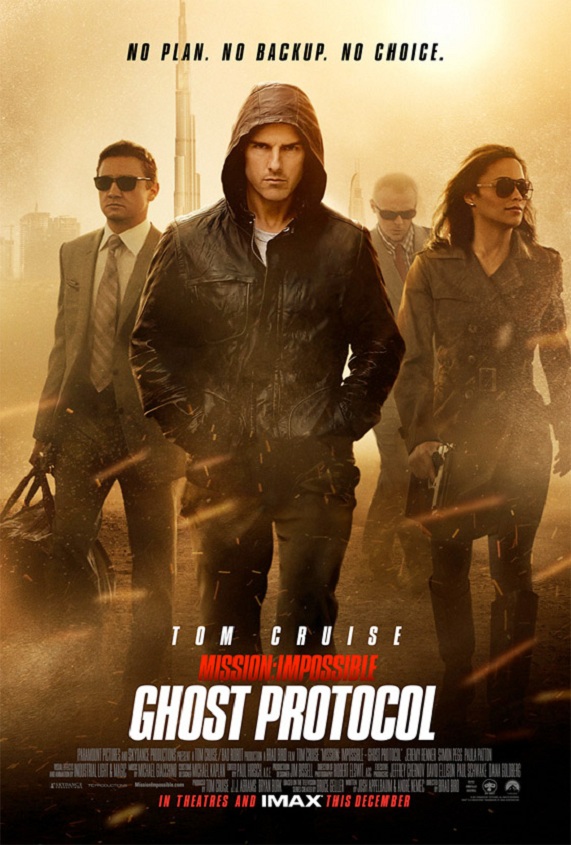
The premise: The MI team, while trying to prevent rogue terrorists (wait, aren’t they all rogue?)…. Let me rephrase. The MI team, while trying to prevent individual terrorists (as opposed to terrorist States) from sparking nuclear war, is intercepted by said individual terrorists who blow up part of the Kremlin. The upshot is that the Russians think the Americans did it. Ah, yes. We miss those Cold War days, don’t we? We were just so well matched: the Russkies and the Yanks. What a clever way to revive the old enmity--although the film is careful to say several times that there’s been a BIG mistake: “We are NOT enemies.”Are we listening, Mr. Putin?
The MI team consists of Ethan Hunt (Tom Cruise), William Brandt (Jeremy Renner, whose acting falters a bit: too casual, too flip for the part), Jane Carter (a tough but feminine, convincing, best-actor-of-the-bunch Paula Patton), and Brit Benji Dunn (Simon Pegg, who plays a hilarious, somewhat cowardly geek, glued to his computer). The story is set in Budapest, Moscow, Dubai and Mumbai. The pacing is perfect. Perfect and seamless from the winsome prison bust that springs Ethan and his lovable oaf friend, Bogdan (Frank Sinatra is key to these scenes), to the heart-stopping human fly maneuvers Ethan must perform on the outside of the world’s tallest building, Burj Khalifa, in Dubai.
Nothing seems ridiculous or over the top in MIGP. There is a calm groundedness, humanity and humility pervading the excitement. And when Cruise explains it all to us with his intense, commanding presence, we just go with it. Women will love MIGP because of the LACK of gratuitous, mindless explosions and chases. There ARE explosions and chases (very cool ones, I might add, one involving the device of a sandstorm) but they MAKE SENSE. I wouldn’t doubt that J. J. Abrams’ (Bad Robot Productions) genius may be at work here. Even when things get a little overblown (I’m no spoiler!), you really won’t care because you’ve suspended your disbelief permanently in these expert filmmakers’ hands.
And it’s FUNNY. I mean, really funny. In all the right places. The agents fail a lot in MIGP. Things do NOT go smoothly at any point. Sometimes they lose nerve. They’re humans, not machines. This is such a welcome change in action movies! There’s an earnest, average Joe, underdog aura here.
OTHER STUFF:
--The gadgets are cooler than Bond’s.
--A lot of the fun is in the little details.
--See Tom run. And run and run and run and run and run.
--Um, I did not count ONE swear word. Not even “damn” or “hell.” And swearing would have been mighty appropriate in even one of these sticky situations. AND the name of the Lord was NOT taken in vain! Whoop! (When good men lead—including in Hollywood—good things happen. Thanks, guys. I also think family men are more sensitive about these things—directors like Abrams, Nolan, Spielberg, etc.) Also, very little boobs and gore. Pretty “family-friendly” action film.
--Very creative predicaments.
--Budapest, Moscow, Dubai, Mumbai: beautiful cities!
--Most unnecessary line of dialogue: “I. Need. That. Briefcase.”
--Best use of a car’s air bag in a film. Ever.
--Too bad Oscar doesn’t care about action-thrillers. Sigh.
--Dos Equis! Dos Equis!
--Love the old-time “Mission Impossible” music, graphics and cinematography at beginning….
--MIGP: brains and brawn.
--Catch the long DEAD SILENCE scene. Awesome.
--“Our media is no more truthful than yours.” –Russian to Tom Cruise.
--Good cat fight with unexpected ending.
--Is that how people park their cars in Mumbai?
--Moreau looks like a 14-year-old baby doll assassin.
--MIGP is devoid of snarky one-liners! MIGP is simply devoid of snark all together! Hip, hip hooray!
--The amazing Brad Bird directs (who woulda thunk it?)—yes, Brad Bird of stellar animated films fame: (“The Incredibles,” “Up,” “Ratatouille”). I guess a good story teller is a good story teller is a good story teller.
--Agent Jane Carter actually takes off her high heels to run! What a concept!
--Did anyone else think of Steve Jobs seeing Tom in the dark hoodie?
--The very end is lame and tame, opening the way for a sequel, but after such a sharp film, couldn’t it have been a little more snappy?
January 5, 2012

January 3, 2012
"COURAGEOUS" DVD AVAILABLE JANUARY 17!
What is "Courageous"? Only THE most Theology of the Body movie for guys EVER....
For more information on the movie, please visit
January 1, 2012
Subscribe to:
Posts (Atom)