My testimony and a talk on Theology of the Body and women.
June 27, 2017
RADICAL FEMINISM TO FEMININE GENIUS (THEOLOGY OF THE BODY)
My testimony and a talk on Theology of the Body and women.


June 8, 2017
GENDER & LGBTQ (THEOLOGY OF THE BODY) PODCAST
Part 1 begins with a little introduction to Theology of the Body....
May 29, 2017
NETFLIX: "THE KEEPERS" (WHO KILLED SR. CATHY?)

Netflix's truth-is-stranger-than-fiction docuseries, "The Keepers" (unofficial subtitle: "Who Killed Sister Cathy?") is beyond disturbing. Just when you thought you'd heard some of the worst, most sordid stories of the clergy sex abuse scandal, another multi-pronged, intricate, twisted tale of predatory characters and those who shielded them emerges in all its sickening ignominy.
MIND-BOGGLING
But this time, there's a beautiful-in-every-way young nun involved, deeply involved. So involved, in fact, that she's (coincidentally?) murdered in cold blood and her body dumped in the woods--as a warning to never break the silence, never tell tales out of school (literally)? The impunity with which pedophiles, perverts, sexual deviants, sadists and life-destroyers operated in the Catholic Church virtually unchecked until 2002 is as appalling as it is mind-boggling.
EVIL PROTECTED
"The Keepers" chronicles the reign of terror of a particularly evil Fr. Joseph Maskell (who had studied psychology himself) and a priest associate, Fr. Neil Magnus, along with several non-clerical co-abusers in Baltimore , Maryland --the primatial see of the Catholic Church in the United States
CONDITIONING
To understand how so many young women (and others) could have kept silent for so long--not even talking to their parents, each other, the nuns that taught them (some nuns at least seemed to know something was wrong but chose to either live in denial or look the other way and not rock the boat), you need to understand that this is normal for trauma victims. You also need to understand the kind of pedestal that priests were put on for the better part of the 20th century in America. They were sacred authorities, super-human, not like the rest of us, automatically virtuous and displaying holiness of life in everything they said and did, never wrong, beyond reproach, unquestioned, esteemed. No one dared confront or challenge them. It was unthinkable. It would be like confronting or challenging God's very representative. Their power was absolute. Much of Maskell's abuse was heinously "spiritualized" as a kind of penance. Break down a young person's already fragile self-esteem and join that to a religious guilt dimension? You've got 'em.
Many abusive clergy (or how I like to think about it: "pedophiles/psychopaths who got themselves ordained") used textbook grooming, conditioning, threats and criminal genius, toxically coupled with the entrenched power and influence of the mighty Catholic Church, with its reaches deep into people's strongest religious beliefs, families, ethnic cultures, faith practices, memories, neighborhoods, schooling, upbringing and formation.
There was also a kind of homogenous social conformism in society at this time, as well (remember that concurrent to the Swinging 60's was Camelot): a kind of unhealthy, passive obeisance to any kind of authority or authority figures.
MY "NO PEDESTALS" DAD
I thank God every day that my dear, devout Irish Catholic father was also a woke, free-thinking, shrewd, egalitarian, intelligent, worldly, self-made New England businessman who brooked no guff from anyone, even those on pedestals. We were never, ever taught--and he didn't model--any special treatment for priests. My father would say of anyone who tried putting on airs: "they put their pants on one leg at a time, just like everyone else." In his younger years he had a beloved long-time golf partner, Monsignor Sheridan, of whom he spoke often and fondly. We were casually acquainted with the priests at various parishes (we were parish-hoppers)--but that's about it. My father had had run-ins with various clergymen through the years--over their demands for money and other slights (which could have given him plenty of excuses to leave the Church), but my father believed the Catholic Church was the Church of Jesus Christ and no ungracious human shepherd was going to send him packing. I always sensed a certain unspoken prudence and reserve in my father when it came to the church (little "c").
JEAN, CATHY, JOYCE
One of the worst-abused students from the 1960's, Jean Hargadon Wehner, came forth in the 1990's--after horrifying repressed memories began to surface and give her no peace. In all innocence, good will, honesty, courage and uprightness, she reported it to the Church. The Archdiocese of Baltimore made her believe that she was the first to come forth with a report of abuse (she wasn't). A team of crack lawyers were assembled and arrayed against her to successfully stonewall. And very sadly, the otherwise astute head psychiatrist at John Hopkins, Dr. Paul McHugh, was an expert witness in her case against the validity of repressed memories--even ridiculing with levity the very concept. We know much more now--even from the 90's--about how repressed memories actually legitimately work.
So where does the murdered Sr. Cathy Cesnik, SSND, come in? When she was murdered in 1969, and her body found two months later, no one had any clue why anyone would target this beloved, spunky and innovative, twenty-six-year-old teacher from Archbishop Keough High School
It was only when the sexual abuse at Sr. Cathy's school came to light in the 90's that a motive for her murder surfaced--was she going to expose Fr. Maskell? Abused students had begun to confide in her and she promised that she would make the abuse stop. DNA evidence does not put Maskell at the scene(s) of the crime, but several witnesses in the documentary posit other likely suspects who may have been doing his bidding (blackmail? payoffs?)
The police work at the time? Shoddy at best. Sr. Cathy's murder wasn't even considered foul play for quite some time--even when her car was found crazily parked with evidence of a chaotic event inside and outside of the vehicle. Other potentially damning evidence disappeared. Survivors claim they were also abused by police in uniform, under the auspices of Fr. Maskell.
GEMMA & ABBIE
Now, if you think this series is based on the evidence of a few survivors and one zealous documentarian, you are sadly mistaken. Time is the great discloser. The birds start singing. The puzzle pieces start to fit together. Now-white-haired journalists from 1969 who were shut down when they got too close to the truth--remember all the frustrating details as if it were yesterday. Kids who witnessed grownups talking (or worse) are adults now with corroborating stories to tell (even though they hadn't heard each other's stories).
But the two real heroines of this documentary are two former students of Sr. Cathy who were not abused and had no idea what was going on right under the roof of their alma mater. (One was inspired to become a teacher herself by the example of Sr. Cathy.) These two determined ladies, Gemma and Abbie, in their retirement, decided to do their own sleuthing (the filmmaker came calling later in the game). They began pouring over microfiche, contacting anyone who knew anything about the school, the priest, Sr. Cathy, Joyce, even the police on the cases. These two dogged detectives got very, very far on their own.
But the two real heroines of this documentary are two former students of Sr. Cathy who were not abused and had no idea what was going on right under the roof of their alma mater. (One was inspired to become a teacher herself by the example of Sr. Cathy.) These two determined ladies, Gemma and Abbie, in their retirement, decided to do their own sleuthing (the filmmaker came calling later in the game). They began pouring over microfiche, contacting anyone who knew anything about the school, the priest, Sr. Cathy, Joyce, even the police on the cases. These two dogged detectives got very, very far on their own.
FOCUSING ON SURVIVORS
"The Keepers" (like "Spotlight") appropriately and justly focuses on the survivors, not the incredibly intriguing "Who Killed Sr. Cathy" component: macabre, and all-important as it is. You will love Sr. Cathy, who is, perhaps, a true saint and martyr. And she wasn't posthumously canonized by wistful, dreamy remembrances. Her students and her family knew she was great, even before she was cut down in the prime of life--as a sacrificial lamb, it seems. I hope I have even a fraction of this woman's guts.
You will also love Jean--a very average woman, with no particular resources or inner reserves of strength to have endured the awful, awful hand that life dealt her. But she was blessed with a large, close family (siblings) and a phenomenal husband and children that gave her all the love she needed to face down the institutional evil that made her suffer and bear the brunt of its flagrant abuses and subsequent intransigent injustice.
NEVER AGAIN
It's difficult to comment on a series this long--I have so much more to say--but I think I've hit the salient points. Should you watch it? Many of my friends have said they just couldn't stomach it after just the first two episodes. They could handle neither the lurid, detailed descriptions by survivors of the grotesque abuses (if you want just a sample: http://www.cosmopolitan.com/uk/reports/a9882211/father-joseph-maskell-netflix-the-keepers-abusive-priest ) nor the murder of Sr. Cathy.
I watched the entire series in order to understand, in order to honor the suffering of the survivors and HEAR THEIR STORY. It's no good to finally, finally, finally GET TO TELL YOUR STORY IF NO ONE LISTENS.
PLEASE READ!
Here's my movie review of "Spotlight" (also a fine work) where I give some historical background to the clergy sex abuse scandal, as well as some pointers on how we can attempt to assure for the future: NEVER AGAIN.
http://hellburns.blogspot.ca/2015/11/spotlight-is-recounting-of-spotlight.html#.WSzQFWjyuM8
http://hellburns.blogspot.ca/2015/11/spotlight-is-recounting-of-spotlight.html#.WSzQFWjyuM8
OUR BELEAGUERED PRIESTS
On behalf of all the good guys, the majority of priests, the clergy sex abuse scandal is not part and parcel of the structure of the priesthood or celibacy (read my "Spotlight" review)! Tragically, our priests, young and old, now have a stigma attached to their "profession." This need not be. In the USA, you're innocent till proven guilty, and there's no reason to look askance at any priest. Just take a page from my Dad's playbook: "we're all human." Or my own playbook: "put nothing past no one." I remember in 2002, bunches of priests, horrified by the revelations (not all priests were privvy to the horrors going on within their own dioceses) began doing some forms of public and private penance. Let's pray for our priests. We love them and we need them.
THE CHURCH DID THIS TO ITSELF
A friend of mine said of the clergy sex abuse scandal: "It's Satan trying to take the Church down." To which I replied: "And the Church trying to take the Church down." When a male victim of Maskell was asked by the Archdiocese of Baltimore what he wanted when he came forward (he was sarcastically offered a boat), he replied: "For the Church to do the right thing."
FOLLOW UP:
http://nypost.com/2017/06/17/netflix-is-now-helping-cops-solve-cold-cases/
FOLLOW UP:
http://nypost.com/2017/06/17/netflix-is-now-helping-cops-solve-cold-cases/
May 19, 2017
WHERE'S SR. HELENA? WHERE IS SR. HELENA? WHERE'S SISTER HELENA? WHERE IS SISTER HELENA?

Where's Sr. Helena?
People have been asking for years how they can track where I'm traveling to/speaking at.
So, here you go!
Just scroll down to the events:
http://daughtersofstpaul.ca/mission-events
(To return to this blogpost for updates, just Google: "Where's Sister Helena?")
MOVIES: "GIFTED"
The small film, "Gifted" (small in scope, feel, settings, and in its pint-sized protagonist) is delightful, well-crafted and asks the question of what it really means to be a successful human being, what it really means to be "gifted."
Mary, a seven-year-old math prodigy like her mother (who committed suicide) has been raised by her uncle, Frank (Chris Evans), from infancy. We have an inkling that Frank might also be highly intelligent in his own right (he uses a lot of big words)--and we find out later that he used to be a philosophy professor, but now fixes boats and lives in a very modest housing complex with Mary and their one-eyed cat, Fred. However, the arrangement is unofficial and hasn't been ratified in the court system. Frank is homeschooling her because she's too smart for school, and can be rude and impatient with her peers. Roberta (Octavia Spencer) is the earth mother landlady whom Mary loves and who helps her to be just a little girl, have fun, and be warm and huggy. But Frank decides it's time for Mary to go to a regular school, so Mary reluctantly trundles off to the big yellow school bus. Roberta warns Frank that the shaky legal status of he and his niece could now easily be exposed and he could lose Mary. Frank doesn't seem too concerned. Everyone at school assumes he's Mary's dad, and he lets them.
MARY, MARY QUITE SARDONIC
Needless to say, Mary acts up and acts out on her very first day. She is bored silly and becomes sarcastic with her teacher, Bonnie (the squeaky-voiced Jenny Slate who gives a nuanced performance), and her fellow students. Bonnie practically stumbles across the fact that Mary is a genius. When Mary claims the little math problems she's given in class are "easy," her teacher throws an equation at her that no first-grader could pull off. (We know where this is deliciously going.) Mary does. Bonnie tries something harder. Mary does it in her head. The next, even harder problem that Mary does in her head, Bonnie needs a calculator for.
The tale starts off with heavy-handed exposition and super-stylized mis-en-scenes, but then relaxes into a more standard, almost made-for-TV dramatic milieu. But it's a comfortable style, and well-suited to this as-yet-unknown little girl whom we know will not have the luxury of remaining anonymous much longer.
THE COOL UNCLE
Although Mary doesn't know how to be a kid, her uncle knows how to handle her and her giftedness, and they have a great relationship. After a few incidents at school, she and Frank have a chat. He tells her that she knows she's not supposed to "show off," and that she should have "compassion" on what she calls "idiot kids."
Chris Evans is almost "too big" for this movie--not just his Captain America star power, but his acting style and his movements: pause, linger, smolder, barely move, let the camera lean in and do all the work, barely emote, barely react, activate radio voice.... Maybe it's the director. Frank is meant to be the mysterious, nonconformist, "damaged hot guy"--but he's just a little too suave and casual somehow. Too much mugging and scenery chewing. Sorry. And I really like Chris Evans as an actor. He's just not displaying the earnestness of "Puncture."
And what of his petite co-star? Au contraire! This little actress may not be a real math savant, but she's certainly a thespian savant. Not one false note. A real natural. Her many contorted faces are the faces a real kid makes--and those tears! But then again, what is it with child and teen actors these days? Even mature, seasoned actors admit: "they're better than us."
"STEM" PROPAGANDA?
Enter, Grandmother. Grandmother (Frank's mother who prefers to be called "Evelyn" by her progeny) is the cold-as-ice British matriarch, a somewhat frustrated mathematician who may have lived vicariously through her daughter and may have even pushed her daughter over the edge. She wants Mary to be in a gifted school to reach her full "potential." Frank insists that it was his sister's wish that he raise Mary as a normal kid.
There's are some sad little jabs where Mary realizes that figuring out who can/should/wants to raise her is a bit of a problem for everyone. She also realizes that Evelyn kind of regrets having children because "after children...no more math." "Gifted" also seems to be a bit of "girls in STEM" propaganda. I mean, I'm all for equality and progress, but what if the majority of young women aren't terribly interested in making STEM their career or their life? Is that OK?
Evelyn fights valiantly in court to gain custody of her granddaughter (employing the aid of Mary's deadbeat Dad). She is vilified by Frank's lawyer, but smartly defends herself and her view of what is best for gifted individuals (and humankind), claiming that her deceased daughter "knew the responsibility she had been given" to make things better for all humanity.
The beautiful takeaway from "Gifted" is that being "gifted" is so much more than our talents, skills or abilities. Or as Mary says about Frank: "He wanted me before I was smart."
OTHER STUFF:
--As a philosophy aficionado, I recoiled in horror at Evans' mangling of "Cogito ergo sum."
--Frank talking with Bonnie about his "getting laid," as well as jumping in bed with Bonnie on the first date, cheapens Frank/Evans, Bonnie/Slate, "Gifted," all.
--There's a lovely little God dialogue--a bit of a cop-out and "throwing God a bone," but it has a nice "reason AND faith" ending:
Mary: Is there a God?
Frank: No one knows.
Mary: Jesus?
Frank: Good guy. Do what he says.
Mary: But is he God? (Roberta's a "believer.")
Frank: Be smart, but don't be afraid to believe in things, too.
Mary: Is there a God?
Frank: No one knows.
Mary: Jesus?
Frank: Good guy. Do what he says.
Mary: But is he God? (Roberta's a "believer.")
Frank: Be smart, but don't be afraid to believe in things, too.
I actually met a mom in New Orleans who had a little genius son and daughter (she and her husband aren't sure where their kids got their brains, either that or they were just being humble). The son was the elder of the two and was invited to attend a particular college while still in elementary school. He sat down with his parents and the administrators and told them he wasn't interested in going to their secular college because he wouldn't be able to talk about God there, and God was the most important thing in his life. He was presently going to a Catholic school where he could talk about God, and he liked that better. :)
April 30, 2017
NETFLIX SERIES: "13 REASONS WHY"
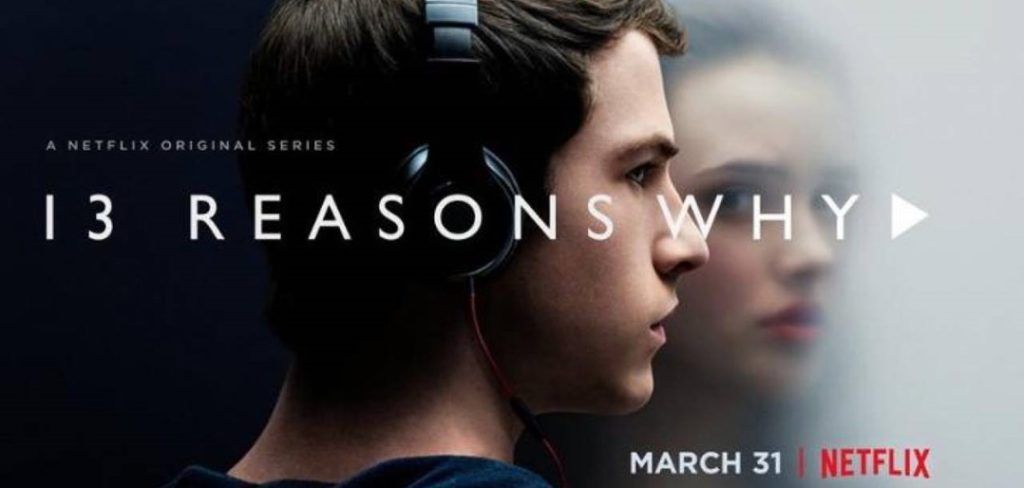
LOTS OF SPOILERS BELOW BECAUSE THIS IS NOT ENTERTAINMENT.
This series got
ME very, very depressed. The full-on suicide was horrific.
The filmmakers REJECTED THE ADVICE OF EXPERTS TO NOT REPRESENT THE SUICIDE WITHOUT CUTTING AWAY. (Rather than being irresponsible, I think they probably put artistic license before humanitarian prudence--thinking that brutal "art" could "save.")
The filmmakers REJECTED THE ADVICE OF EXPERTS TO NOT REPRESENT THE SUICIDE WITHOUT CUTTING AWAY. (Rather than being irresponsible, I think they probably put artistic license before humanitarian prudence--thinking that brutal "art" could "save.")
COPYCAT SUICIDES
Suicide is the
#2 killer of teens today (North America). There are always copycat suicides
after popular depictions (or news stories covering actual teen suicides) of
teen suicides: this is exactly what happened after "Dead Poets
Society." The copycat suicides are hushed up by first responders and news
media, or they used to be, JUST for the fact of even more copycats.
"The first season of "13 Reasons" violated almost every scientific recommendation for presenting suicide in the media." --Psychiatrist Dr. Mark Sinyor (this is his field of study) <---click article="" for="" p="">
"The first season of "13 Reasons" violated almost every scientific recommendation for presenting suicide in the media." --Psychiatrist Dr. Mark Sinyor (this is his field of study) <---click article="" for="" p="">
I think the verdict is now out. The wildly-popular, or at least
widely-seen Netflix series "13 Reasons Why"--(based on the
book by the same name) about a teen girl who commits suicide--may actually have the reverse effect of its
intended purpose. The purpose of the book/series was to prevent teen
suicide by graphically depicting one, as well as the events leading up to it,
all narrated by the deceased girl herself.
I'm going to recommend the 5 articles below and one audio interview--which all urge great caution in the viewing of the series. Adults should certainly see the series so they can talk about it with teens who have seen it (or may have seen it secretly). It is vital to just start talking with your teens about the series, about teen suicide and about the many, many other issues brought up in the series. Teens WANT and NEED to talk with trusted adults about this series.
I'm going to recommend the 5 articles below and one audio interview--which all urge great caution in the viewing of the series. Adults should certainly see the series so they can talk about it with teens who have seen it (or may have seen it secretly). It is vital to just start talking with your teens about the series, about teen suicide and about the many, many other issues brought up in the series. Teens WANT and NEED to talk with trusted adults about this series.
IMPORTANT
RESOURCES
--EXCELLENT! A mom-psychotherapist weighs in (INCLUDES THE CODE OF ETHICS FOR NEWS REPORTERS ON REPORTING ABOUT SUICIDES. "13 REASONS WHY" HAS DONE THE EXACT OPPOSITE): http://www.foxlevineandassociates.com/blog/2017/4/19/13-reasons-why-and-its-unintended-consequences
--Aleteia is the Vatican's social media outreach: http://aleteia.org/2017/04/25/is-your-teen-watching-13-reasons-why-heres-why-you-should-be-concerned
--Aleteia is the Vatican's social media outreach: http://aleteia.org/2017/04/25/is-your-teen-watching-13-reasons-why-heres-why-you-should-be-concerned
--Netflix Series
Shows No Options To Help Address Suicidal Thoughts [beyond a website at the
very end of the entire series and an epilogue by the filmmakers urging students
not to kill themselves]: https://www.pressreader.com/canada/toronto-star/20170428/282230895586114
--"Ontario
Schools Warned To Avoid TV Series on Teen Suicide--Ministry Says Show
Romanticizes Suicide and Makes Victim Seem Heroic" https://www.pressreader.com/search?query=ontario%20schools%20warned%20to%20avoid&languages=en&hideSimilar=0
--Parents Should Be Scared Because "13 Reasons" Shows How Little Parents Know About What's Going On In Their Teens Lives (On- and Off-line): https://qz.com/970701/what-should-really-scare-parents-about-netflixs-13-reasons-why-isnt-the-teenage-suicide/
--Parents Should Be Scared Because "13 Reasons" Shows How Little Parents Know About What's Going On In Their Teens Lives (On- and Off-line): https://qz.com/970701/what-should-really-scare-parents-about-netflixs-13-reasons-why-isnt-the-teenage-suicide/
--EXCELLENT! Relevant
Radio interview with experts: http://relevantradio.streamguys.us/MA%20Archive/MA20170427b.mp3
What I would really love is to hear from teens themselves (those
at risk for depression, suicide, etc., and those who are not but may have
friends who are) as to how they are processing it all. (Hint, hint: comment on
this blog post. Thank you!) Some are saying it is helping them to realize they need to be kind and little things can hurt a lot. Other young people are saying that they don't see any hope in the series--even though most people watched it all the way through waiting for something hopeful, some solution! Some teens are saying: but that's not real life! There IS hope!
Adults may want to begin watching the series with the very last
episode which is actually an Epilogue with actors, director, producers and
psychologists speaking about the making of the film (with clips of scenes). But
it is not enough to watch this one episode. Teens have seen the whole series:
you need to also.
SUPER INTENSE, SUPER
DARK, SUPER HOPELESS
The filmmakers
had the best of intentions, but for all their filmmaking and teen-brain
expertise, they failed to see that you cannot control/direct how the majority
of teens may very well process this super intense, super dark, super hopeless drama.
And
when you're a teen, who are you going to side with: adults telling you NOT to
do something? Or a teen rebelling against everything around herself and keenly
and articulately going on and on and on giving reasons for her suicide for
hours and hours of the series so that she has the last word and is in final control of the situation?
Hannah Baker, the new girl at school, is lonely and suffering. A
series of events, including sexting, rape, male objectification of females:
physical/emotional/verbal, teenage drinking, teen sex, bullying, a fatal car accident
she inadvertently and indirectly "caused," betrayal of friends, etc.,
led her to give up on life. Before she kills herself, she meticulously records
13 old-school cassette tapes to explain her "13 reasons why" she
killed herself. Each of the 13 reasons are a person that she effectively blames.
One young man in particular, Clay Jensen--as sweet and genuine as Hannah, with
whom she began a romantic relationship--is taking it very, very hard, of course.
Due to his shyness and awkwardness, he wasn't always "there for her,"
and so he is majorly blaming himself.
There are 3 teen deaths: Hannah's suicide (slit wrists), Alex's
suicide (gunshot to head), and teen boy in car accident.
The series is realistic, gritty, and goes into the many heavy
issues facing teens today. The dialogue is in-depth. It is very rich because of
dealing in depth with so many teen topics. I'm sure teens will feel honoured by
the very fact that someone cared enough to show the world what they are really
facing (although, certainly, most teens aren't facing all of the issues
portrayed). But that's not good enough. There is only one glimmer of hope at
the very end when Clay reaches out to another isolated girl. But that's it. One
psychologist is calling this "negative flooding" or "exposure
therapy" which can actually work to make young people COMFORTABLE WITH
SUICIDE. The negativity is soooo overwhelming.
Here's a seeming correlation of the influence of "13 Reasons" on young people:
"The difference is we've seen a more rapid increase in numbers than we've ever seen," said Dr. Ajit Jetmalani, the head of Child and Adolescent Psychiatry at OHSU's Doernbecher Children's Hospital. "The pattern is similar, but it's the actual numbers that are alarming."
Here's a seeming correlation of the influence of "13 Reasons" on young people:
"The difference is we've seen a more rapid increase in numbers than we've ever seen," said Dr. Ajit Jetmalani, the head of Child and Adolescent Psychiatry at OHSU's Doernbecher Children's Hospital. "The pattern is similar, but it's the actual numbers that are alarming."
http://www.oregonlive.com/
In his review, Christopher West makes the point that we shouldn't turn away from "13 Reasons" because WE'RE uncomfortable. Are we shunning/avoiding the ugliness that young people face every day? Are we refusing to know, understand, enter into their pain?
In his review, Christopher West makes the point that we shouldn't turn away from "13 Reasons" because WE'RE uncomfortable. Are we shunning/avoiding the ugliness that young people face every day? Are we refusing to know, understand, enter into their pain?
http://corproject.com/209-see-13-reasons-wants-show-us/
However, here's another psychiatrist who's been able to study the series at a bit of a distance now:
https://www.pressreader.com/canada/toronto-star/20170529/281895888195950
And this:


However, here's another psychiatrist who's been able to study the series at a bit of a distance now:
https://www.pressreader.com/canada/toronto-star/20170529/281895888195950
And this:


LOOKING FOR A PURPOSE
At one point before her complete downward spiral, Hannah says: "I need a purpose in life." Unfortunately, it's just a passing thought and this theme is not explored. Don't underestimate the ability of a teen to have a serious existential crisis. I did. And I seriously didn't want to live any more. I didn't know God yet and couldn't figure out why I was alive, what it was all for. Life seemed utterly absurd (even without the sufferings Hannah endured). And don't underestimate teens' ability to latch on to something challenging and true that might help in all the confusion. John Paul II wrote "On the Christian Meaning of Human Suffering" after he was shot. The point is not to just blithely accept suffering (we should try to relieve most types of human suffering, certainly), but it can make the world of difference to know that suffering can be redemptive: https://w2.vatican.va/content/john-paul-ii/en/apost_letters/1984/documents/hf_jp-ii_apl_11021984_salvifici-doloris.html
There is so much I want to say about this series. I took 10 pages
of notes! Hopefully, I will begin slowly adding topics/subsections to this blog
post. But for now, I concur with the 6 resources above.
Oh, and here are some hopefully hope-filled tweets I was inspired to post:


April 29, 2017


April 25, 2017
MOVIES: "BEAUTY AND THE BEAST"

The live-action "Beauty and the Beast" is a lovely
and faithful rendition of the animated version--faithful to the point of an
almost frame-by-frame facsimile. Emma Watson as Belle and Dan Stevens as The
Beast play their roles with precision. The stunning Audra McDonald--that voice!--plays
the operatic chifferobe.
"GAY" OVERTONE?
There was a much-publicized (before the film even released)
"gay kiss" and "gay overtone" to the film--a rather false
claim. I didn't see anything remotely like a "gay kiss," and neither
did anyone else I quizzed who saw the film. The same-sex affection of LeFou (Gaston's
manservant) to an oblivious Gaston (the incomparable Luke Evans--looking like
Errol Flynn) is shown briefly in a comment or two, and then in a sophisticated double-entendre
song (with enhanced entendre, differing from the animated version). Children
would surely miss the alternate meanings. But here's the thing. LeFou and
especially Gaston are horrible people! Gaston in particular is murderous,
conniving--hopelessly pompous, conceited and in love with no one but himself.
There is no way the filmmakers were trying to "promote acceptance of a gay
lifestyle" by putting forth treacherously villainous "gay
characters."
However, there is a quick, troubling scene where manly
soldiers fighting in the castle are instantly and magically dressed up as "Marie
Antoinette" style women: the voiceover says something to the effect of:
"Go forth! Be free to be pretty little boys!" Instead of the soldiers
being horrified, they embrace their "inner woman" with delight.
Hmmm....
BEAUTY IS WITHIN
A distinctively delicious, seasoned British female narrator
gets us right into the story, overemphasizing every precious syllable of every
familiar, winsome word. We hear and see The Beast's back story, the curse, the
harsh punishment and high stakes he is engaged in. We can see immediately
that--although a pretty exact replica of the animated version--this is not
going to be a lazy re-telling. No effort will be spared to spin a lavish yarn. There's
lots of CGI, but the virtuality is well-blended with actuality. (CGI is well-justified,
what with the walking, talking clocks, candelabra, chifferobe, footstool, tea
cups, etc.) The wonderful dictum, premise and "karmic statement" is
pronounced by the rebuffed enchantress to the selfish prince-turned-animal:
"BEAUTY IS WITHIN." The prince-turned-Beast must get someone to fall
in love with him or he and his whole household will remain frozen as they are:
he, a beast, and they, inanimate objects.
The opening scene is a big musical number in the little
French village which is our setting, and we sit back and relax and go along for
the ride. The pace and exposition is pretty exquisite: clever and never
lagging. Belle, while externally beautiful, is also "different," like
The Beast himself. She's a bookworm (an unusual pursuit for young ladies of the
time). Therefore, in a sense, her beauty is also "within." Her
deceased mother--from Paris--was also different, "until people started
imitating her." [Incidentally, my own father was a clothier, and in his
later years did not dress so dapperly any more. When we would bring this to his
attention, he would boom: "I AM fashion!"] Belle's father, a kindly
Geppetto-like man, is a watchmaker. Kevin Kline plays this rather minor
character with nuance, warmth and relish.
TAMING THE BEAST
Belle's father heads into town and Belle asks for only one
item--as is her tradition: a rose. The father's horse gets lost and they wind
up at the Beast's castle for the night, but they don't encounter The Beast
until, on his way home, Belle's father innocently picks a rose from The Beast's
garden. The Beast imprisons him in the castle. The horse gallops back to Belle
who has him take her back to the castle where she tricks both her father and
the Beast into letting her take her father's place. This act of kindness begins
to melt the Beast's icy heart ever so slowly--especially when he realizes that
she might be a savior if he can get her to fall in love with him.
Meanwhile, Belle's father returns to the village and tries
to recruit help, but his story sounds fantastical. Gaston--enraged with
jealousy that Belle may be falling in love with The Beast--has her father
locked up as insane, stirs up the townspeople through fearmongering, and they all
set out chanting "kill the beast!"
DISNEY BELLES
I think I would like to have seen a longer character arc for
The Beast--where he doesn't get so easily "tamed." I would rather have seen
more of Belle and Beast working it out, fits and starts, victories and
setbacks--all because of his character flaws (and maybe a few on Belle's part!)
Like Katniss in "Hunger Games," Belle is near-perfect with no
character development necessary. I guess that's becoming true of all Disney
heroines: just be "feisty" and "strong" and buck all
"feminine gender roles"--as if that's the only kind of girl-woman we
should want to emulate. The Beast could have been even more scary and merciless
at the beginning, even though he cruelly imprisons Belle's father: "a life
sentence for a rose"--as he was given. The Beast speaks of his own
punishment as "eternal damnation," presumably because fairytale
characters and creatures never die!
TALE AS OLD AS TIME
The particularly charming title song: "...tale as old as time, song as old as rhyme: beauty and the
beast," remind me of John Paul II's phrase in regard to male-female
love: "the perennial gift," and also the fact that while men civilize
the world for the benefit of all humanity (transcendence), women
"civilize" men--for the benefit of all humanity (immanence). Men are experts at the impersonal/objective, while women are experts at the personal/subjective. Both types of truth must always work together. Men are experts at the impersonal/objective, while women are experts at the personal/subjective. Both types of truth must always work together, hand in hand, like a dance.
OTHER STUFF:
--Audra McDonald singing "Summertime": https://www.youtube.com/watch?v=dNLbRdoB9Z8
--At times, the soundtrack is like a 1940's film.
Purposefully, I'm sure.
--I would have appreciated some silence in the film, but
it's the only slothful move in the filmmaking: a constant, bombastic score.
--"The prince had a good mother, but a bad father who
twisted him up."
--Makeup/costume/CGI managed to make the Beast handsome
throughout.
--Isn't it true and strange? Guys can be kind of grizzled
and women will still find them attractive. Or even more attractive.
--Couldn't help thinking of the remotely similar story line
of "Phantom of the Opera."
--"Be Our Guest" is also a great song.
April 17, 2017
MOVIES: "FROZEN"

Here it is, folks. My long-awaited review. Why so short? It doesn't deserve more than this.
-thin story -bad music -mean-spirited -minimal sets -useless men -unfunny snowperson -underdeveloped relationships
Dr. Jordan B. Peterson calls "Frozen": "an absolutely appalling piece of rubbish." #vindicated #NoFro
April 3, 2017
MOVIES: "BITTER HARVEST"
The new film, "Bitter Harvest," is a long overdue depiction of the "Holodomor"--the starvation of 7-10 million Ukrainians (1932-1933) at the order of the communist Soviet Union's Jozef Stalin. Does it succeed as a film? Not exactly, but it should still be viewed in order to raise awareness and get a quick history lesson (so many films today neatly serve this vital purpose). Why did Stalin do this? Ukrainian opposition to Soviet confiscation of their lands, and other harsh, imposed policies. And even more astonishingly: HOW did Stalin do this? He closed the borders (so there was no escape nor news of the horror abroad) and sent henchmen to wrest every last grain of wheat, every last bit of food from the populace.
HOLODOMOR
Before the Nazi Holocaust, there was the Holodomor. Mass-scale slaughter is the fruit of atheistic, anti-human ideologies that see persons as disposable "problems"--standing in the way of "progress."
The film begins by showing us the pre-Soviet Ukraine ("breadbasket of Russia") dreaming of freedom from the long reach of the Russian czar, but living the peasant life of hard work and simple pleasures. Family life is strong, farm workers pause to pray in the fields. There is quick exposition and the story really moves along (it could actually have taken more time here to invest us in the characters). Actually, some of the action is happening so fast (with all the "beats" of the film of equal length) that "Bitter Harvest" could be called the pejorative "episodic." Yuri (Max Irons)--the grandson of a famous Ukrainian warrior--falls in love with a girl of his age when he's still a young boy, and we follow him and his lady love, Natalka (Samantha Barks, who was Eponine in "Les Miserables"), for the rest of the film. Happy times are not to last in the Ukrainian countryside. The Bolshevik Revolution is headed straight for them.
HIDDEN HORROR
Yuri was raised to be fiercely patriotic and is told: "No one can ever break your spirit or take away your freedom." Yuri develops into an artist, marries Natalka and goes to Kiev, even as the Russian noose is tightening around his peoples' neck, including his own family's. Natalka does not go to Kiev, but stays behind to care for their parents and help on the farm. (Stalin's predecessor, Lenin, dies, and Stalin calls him "soft." Stalin will now show no mercy, and he will use the Communist propaganda machine to cover up his hideous plans. Deportations to Siberia begin. "Push them, crush them.")
There are a few scenes that give us an idea of the heroism and suffering endured. The Soviets begin collecting valuables (and eradicating religion). A Ukrainian priest hides gold icons. The Soviet operative demands he hand them over: "There is not God, evil, sin or hell." The priest answers: "Hell is the inability to love," for which he is slain.
THE LONG ESCAPE
Yuri's young artist friend, who also went to Kiev, believes in Communist ideals and believes they will be good for the Ukraine and make it a great nation--until he realizes that controlling, enslaving, murderous ways are part and parcel of the system. Suddenly, artists may no longer express themselves freely. They must create highly-stylized, conformist, promotional, Soviet-art posters. Yuri's friend kills himself and Yuri winds up in prison where firing squads are a daily event. Our film finally slows down a bit as Yuri manages to escape and head back to his wife and family in the country. The rest of the film is a long trek to this effect, wherein Yuri encounters homeless and starving people (who don't really look in too bad a shape), and there are minor uprisings. The rest of the film really drags as Yuri reunites with Natalka and they try to escape the Ukraine.
TOO MILD
The cataclysmic, intentional, sinister, raw, mind-boggling evil and the staggering proportions of the Holodomor are not captured in "Bitter Harvest." I kept waiting for it, but that movie is still to be made. The filmmakers had to make the story personal (the story of Yuri and Natalka), but what transpires is highly improbable--or, perhaps, portrayed improbably. Perhaps an engaging "based on a true story" will emerge from this piece of history, and that will become a great film. Toward the end of this film (the entire drawn out escape sequence) the soundtrack becomes an awful, generically heroic, churning, grinding loop that really grates on the nerves.
UKRAINE TODAY
The Ukraine's struggle never really ended, even after the dissolution of the former U.S.S.R. Through the years, my Ukrainian friends told me that KGB-types continued to hunt down and assassinate those who were Soviet-resisters. Some of my friends won't even use their actual surnames.
Mandatory follow-up viewing: "Winter on Fire: Ukraine's Fight for Freedom" (2015) http://www.imdb.com/title/tt4908644/videoplayer/vi3224023833?ref_=tt_ov_vi , Oscar-nominated for Best Documentary. 6,000 Ukrainians have already died in the Euromaidan-protests-that-became-a-battle-that-has-now-expanded-to-include-the-conflict-over-the-annexation-of-Crimea-by-Russia/pro-Russian separatists.
Mandatory follow-up viewing: "Winter on Fire: Ukraine's Fight for Freedom" (2015) http://www.imdb.com/title/tt4908644/videoplayer/vi3224023833?ref_=tt_ov_vi , Oscar-nominated for Best Documentary. 6,000 Ukrainians have already died in the Euromaidan-protests-that-became-a-battle-that-has-now-expanded-to-include-the-conflict-over-the-annexation-of-Crimea-by-Russia/pro-Russian separatists.
This lovely and winning sentiment bookends the movie:
"Before I grew up
and realized that dragons were real
and evil roamed the world,
I fell in love."
"Before I grew up
and realized that dragons were real
and evil roamed the world,
I fell in love."
OTHER STUFF:
--Another good follow-up film, "The Desert of Forbidden Art" http://www.imdb.com/title/tt1536458/videoplayer/vi2827590681?ref_=tt_ov_vi
--Read history correctly: STALIN WAS AN EVIL BEAST.
--Thankfully, word did eventually get out about the false, manufactured "famine," as well as photographs.
--"Holodomor" literally means: death by starvation. The full horror of what transpired was only revealed after the Soviet Union fell, circa 1991.
--In 2003, Russia signed a U.N. Declaration admitting to the Holodomor.
--I'm wondering if--even when the word got out (see news item below)--the rest of the world at the time just didn't believe such a feat/catastrophe was possible. Compounded by denial on the part of the U.S.S.R., perhaps the Holodomor was just dismissed from our collective consciousness?


--Wassyl Slipak, a Ukrainian opera singer, a singer with the opera in Paris, died in 2016 fighting for Ukraine.


--Wassyl Slipak, a Ukrainian opera singer, a singer with the opera in Paris, died in 2016 fighting for Ukraine.
March 31, 2017

March 3, 2017
TORONTO--LENTEN DAY OF REFLECTION--MARCH 25, 2017

This event is for men and women.
For young women discerning the Sisterhood, there will be a combined vocation discernment component to the day. If you are interested also in the vocation segment, please RSVP to: srhelenaburns@gmail.com
March 2, 2017
MOVIES: "THE SHACK"

Should you see the film? Yes.
Now for my review. Wow. Where do I begin? "The
Shack," the book, is a New York Times bestseller, first published in 2007.
It was written by Canadian William P. Young, who experienced healing in his own
life, and as a Christian, needed to wrestle with the perennial "problem of
evil" question. That's what the whole film is about: one long Job-style
interrogation of God. Now. I highly recommend you read the book first. If you
will not, try to read the book after. I eagerly anticipated this film because I
loved the book so much, but as I watched the film--reasonably well-done as it
is--I began to wonder if this book should ever have been made into a film. A book
is mysterious and haunting (as we use our own imagination), but a film is
"on the nose," spelled out, flat,
and one-dimensional in comparison. This book in particular is mysterious
and haunting as it deals with the Trinity and suffering!
SOUND THEOLOGY
First, the theology. I am hearing accusations of "The
Shack" being New Age. No. This is thoroughly Christian and Trinitarian
(which, of course, is redundant). The book and film boldly take on depicting the Trinity and somehow it
works. This is not a literal: Here's exactly what God "looks like"
(the First and Third Person of the Trinity did not become incarnate). It's
rather a: what if I got to have a long
conversation with God, face to face, about how I don't like how He "set
things up" (forgetting that we keep rejecting His original plan of how He set things up), how the world is, how my
life is? What if I got to go to the Source to ask why? Certainly, we can do that in prayer. Certainly, we can read
the Bible (it's all in there, germinally, at least). "The Shack" is
quite a feat, really. Although lots of answers are creatively given for the
problem of evil, we don't get trite, cliché answers. And it's not cerebral. The
answers all come about relationally.
There are no answers outside of relationship. In fact, there exists nothing in
God's Creation outside of relationship. God Himself is pure relationship.
HELL BURNS
Without giving too much away, I will tell you that Mack, the
troubled husband and father of three, is summoned by "Papa" (God the
Father) to meet Him and Jesus and the Holy Spirit in a shack in the woods.
Sound corny? It really isn't. Especially if you read the book first. Actually,
if you read the book first, anything potentially corny or even offensive will
have its edge taken off. So much of the filmic "Shack" is pretty much
exactly as I pictured it. But the visuals really aren't that important. It's
the heart. It's the essentials that the visuals should never distract us from
(and here I'm not denigrating corporeality at all, only saying that "The
Shack" deals primarily with the spiritual matters that explain and
manifest themselves in and through the physical). If we don't understand
spiritual matters, how will we ever understand physical matters?
"IF WE LOOK FOR
THE BAD...
WE WILL SURELY FIND IT." --ABRAHAM LINCOLN
WE WILL SURELY FIND IT." --ABRAHAM LINCOLN
If you come at "The Shack" assuming it fits into
orthodox Judaeo-Catholic-Christian theology, I think you will find that it
fits. If you come at it with suspicion, ready to attack, to nitpick, you could
probably twist almost anything from the film into cannon fodder. My one (big)
reservation is about hell. There is no mention of hell, only of love and
forgiveness. God does say that "no one gets away with anything," and
that His will is salvific (as it certainly is!), but hell exists, and there is
the possibility that any one of us will choose it. (God doesn't send anyone to
hell. Heaven is a gift and a gift can be refused.) This might simply be a
glaring omission of the film, but a strange one since the film deals with the
problem of evil, punishment, redemption, forgiveness and the afterlife. One of
the explanations in the film for the evil people do is: they are just a product
of their environment (Jean Jacques Rousseau!). Father beats son because he was
beaten by his father, all the way back to Adam. Where is personal
responsibility? However, the film suggests that personal responsibility
involves forgiving those who have hurt you (Jesus' mandate and the words of the
"Our Father.") "Vengeance is mine, saith the Lord, I will
repay" (Deuteronomy 32:35/Romans 12:19).
Hell is even more on my mind at the moment since Jesus is
preachin' about it in today's readings as I write this review: http://usccb.org/bible/readings/022317.cfm
OUR NEED FOR MERCY
At one point, a separate Wisdom figure (a woman) demands
that Mack judge God and judge the world because he seems to be so good at that.
She helps him see the logic of and need for mercy.
GOD IS A WOMAN?
The Trinity was well cast. Yikes. I know this all sounds so
blasphemous and sacrilegious, but it is not. There is nothing glib about
"The Shack," and it's coming from a very good place. I've spoken to
faithful, orthodox Catholics who have endured terrible losses who found the
book very helpful. God the Father is played by Octavia Spencer (there were
rumours that Oprah would be in the part, and she would have done a great job,
but Oprah always portrays such strength. Octavia exudes the warmth and
gentility needed for the role.) Why is "Papa" shown (initially) as a
woman (but still called "Papa")? Because Mack had a drunken, abusive father who beat him and
his mother. "Papa" tells Mack: "I didn't think you could handle
seeing a father just now." It's not a statement that God is not Father, or
has not revealed Himself to us as the "masculine principle" of Father
and Son, or that He is some kind of androgynous, amorphous Being. Mini-spoiler:
Eventually, He will appear to Mack as Father (Graham Greene!) at a stage of
Mack's healing where God says: "for this next part, you will need a
father."
God in His
divinity “transcends the human distinction between the sexes. He is neither man
nor woman, He is God. He also transcends human fatherhood and motherhood...: no one is
Father as God is Father." --CCC #239
“I kneel before the Father,
from whom every family in heaven
and on earth derives its name.”
from whom every family in heaven
and on earth derives its name.”
Ephesians
3:14-15
Jesus is a Jewish carpenter (played by Israeli Avraham Aviv
Alush). The Holy Spirit is an Oriental woman (Japanese actress Sumire Matsubara).
Again, this is not a statement that the Holy Spirit is female. If I recall, in
the book, she is shimmery and constantly appearing and disappearing--not so in
the film. The three actors do marvels with these larger-than-life (what else
could we call them?) thespian tasks.
THEODICY
Rather than try to dialogue with every bit of this
jam-packed yet not over-stuffed exploration of the problem of suffering and
evil coinciding with a good God, I would just like to applaud and second its
explanations. My one criticism might be that it feels a little mild, a little
tame. Where is the passion? Where is the rage? Sam Worthington (whom I really
enjoy as an actor) is terribly miscast (and he's the main character). He
doesn't seem to know what to do with the part. He is not believable, and he
adopts a strange, husky, whispery tone for most of the film. He has a non-typical
Australian accent that almost sounds like a speech impediment (I'm not being
mean or facetious here). His pronunciation of words sounds almost like a thick
Welsh accent--lots of "th" sounds where there are none in English--so
between the low, mumbling tones and the accent, it's often very difficult to
catch his words, and it makes him unrelatable. He doesn't seem like your
average Joe. He doesn't seem like he has suffered (like Casey Affleck in
"Manchester By The Sea"!) He seems like a deer-in-the-headlights
actor who is making us work hard to understand what he's saying.
Like Jacob, we are called to wrestle with God. But there
must come a time when we move on, marked by the struggle. As the saying goes:
suffering can make us bitter or better.
PRODUCTION VALUES
The film has the look and feel of a Hallmark film. The
soundtrack is as vanilla, beige and generic as you can get. It really, really,
really could have benefited from a sparse modern soundtrack rather than the
full-blown, sappy treatment at all moments. It would have given it a whole
different feel that would have been more appealing to a younger crowd and given
it some gravitas. (Full disclosure: I also loved the young boy God figure in
Ridley Scott's "Exodus." I think I go for gritty when it comes to God
in cinema. This does not mean that I personally
want to suffer. I know God is
reading this review, so I just wanted to state that for the record.)
The Southern twangy voiceover at the beginning, coupled with
the tired, recycled Muzak soundtrack sets the tone as "Southern Christian
Movie." I have spoken of this flaw repeatedly in my reviews of
"Christian" films. And I deeply respect Southern Christian culture! I
have been a recipient of its goodness! Nevertheless. Dear Southern Christian
filmmakers: If you want to appeal to a wider audience--even though the film may
actually be set in the South--there must be more to Southern culture than a
lulling, milquetoast approach to God.
Also, advice for ALL movies: We needn't see the "old
world" in Act One as perfectly shiny, giddy and blissful. It can be happy,
but nuanced. There will still be a healthy contrast when the bomb drops.
STRIKING A CHORD AND
HITTING A NERVE
Reports are that people are weeping in cinemas. Tears of
healing. I'm so glad that the film has managed to connect, especially with a
new audience or an audience that never will read the book. I felt that the book
preserved and honored the horror of the tragedy better than the film, but
perhaps that's just my perspective. Perhaps today in our literal, visual
society, people DO need things spelled out for them, perhaps they need to SEE a
little something in order to believe--and that's OK, too. May this film do much
good to people who need family/relationship/tragedy healing to get over their frozen
anger at God and others, and gain a better understanding of reality.
OTHER STUFF:
--Theology of the Body? Right on, as far as
masculinity-fatherhood, femininity-motherhood goes. Really shows how the
father-relationship, the father-wound either orders or disorders individual,
family and societal lives.

--However, the wife is near-perfect. She is perfectly supportive and hardly has an emotion of her own. Some of the reactions and dialogue are not realistic, under these or any circumstances. People just don't talk like that. And I'm not even referring to the Godtalk. In screenwriting, there's something called "the writer's objective" (what the writer is trying to say/get across--and this must be absolutely invisible). "The character's objective" is what the character is trying to say/get across--which should be the only thing we hear. We hear the writer's objective all over "The Shack." It shows the screenwriter's lack of patience and/or craft in burying the need to give the audience information and move the story ahead deep inside the character's objective.
--Bizarre Indian princess story at the beginning, almost
intimating a bizarre and necessary sacrifice. Can't remember if that was in the
book. I sure hope not.
--Possible film heresy:
The Holy Spirit is not Jesus' soul/spirit. Jesus has/is His own human soul.
--Some REALLY great lines and nuggets and quotes. The Holy
Spirit brilliantly (of course!) condemns moral relativism and being our own
arbiters or right and wrong (what the tree of knowledge of good and evil is
really about).
--I like Graham Greene (Canadian!) better than Morgan
Freeman as God. :)
--Read the fascinating story of how "The Shack"
came to be: https://en.wikipedia.org/wiki/The_Shack.
This Wikipedia entry also includes Protestant objections to its theology,
including an accusation of "modalism." Read about William P. Young: https://en.wikipedia.org/wiki/William_P._Young.
Beautiful "Shack" website: www.theshackbook.com
Beautiful "Shack" website: www.theshackbook.com
Subscribe to:
Posts (Atom)