February 4, 2011

MOVIES: "THE KING'S SPEECH"


I did not want to see this movie. I was preparing myself for yawnsville. Nothing of the sort.

“The King’s Speech” is leading the Oscar nominations, and with good cause. Even though we more or less know the premise and the outcome (stammering royal needs to make important speech and somehow does), we don’t know the stakes, the historical situation, and the profoundly human story behind it all.

It’s 1925. British King George V’s son, Albert, Duke of York (Colin Firth in an impeccable performance), has had a life-long stammer. No one has been able to help him. His wife, Elizabeth (HELENA Bonham-Carter), finds an eccentric speech therapist, Lionel, played by that chameleon, Geoffrey Rush. An amusing, ongoing power struggle ensues between doctor and patient, royal and commoner, continuing for most of the film and resolving into the true center here: friendship. And not just a friendship of mutual need, employer and hireling, or a closed-in friendship, but two men who always have in mind their service to the greater good, the common good, to duty and helping humanity.

If it had NOT been a friendship, the therapy would not have worked. This is evident from the best scene in the movie which takes place in Westminster Cathedral. Perhaps we have not plumbed the depths of what Jesus meant when he said: “I no longer call you servants, but friends.” Perhaps we have not tapped the power of true, altruistic, outward-looking friendship enough in our private and public lives. (Another film that highlights the power of friendship to do good in the public sphere is “Amazing Grace,” about William Wilberforce and his friend, the prime minister, who put their heads together to end slavery in England and pass other beneficial legislation during their lifetimes.)

“The King’s Speech” is something like the tale of the three workmen who were asked what they were doing. The first said, “laying brick,” the second said, “installing windows,” and the third said, “I’m building a cathedral!” Albert and Lionel always have sense of the bigger picture. “The King’s Speech” presents a nobility that is accessible and able to be practiced by all. A noble attitude. Something it seems to me we need to recover in today’s society. In fact, has our modern-day eschewing of some semblance of decency and societal mores really gotten us anywhere? I rather fancy them. They served a high purpose and gave direction and peace of mind. To the filmmakers’ great credit, these social mores are presented intact, without “modernizing” them or belittling them.

Just to clarify, without giving too much away—but of course, if we know our history, which I didn’t exactly, it won’t be giving anything away—Albert is not yet “king” when the movie opens. His brother, David, is next in line for the throne.

The exposition in “The King’s Speech” is masterful. There is much timely background we need to know about the famous “years between the wars,” yet we never feel like we’re being “instructed.” Apart from an early scene where Albert and Lionel sit opposite each other and their eye-lines are off and we can see them reading their lines, “Speech” is flawless and seamless.

Albert and the Duchess make a great pair, a great team. A lovely portrait of what marriage can be.

“Speech” is a total showcasing of the craft of acting. Long scenes; long, intense close-ups leave the actors totally exposed. And each actor—without any kind of grandstanding--fills the screen, fills up our cinema with intelligent emotional substance that leaves us rapt. Bravo.

Colin Firth does a fantastic imitation of Albert’s struggle to do something so mundane, and yet so vital, especially for his day (live speeches and radio) and his rank (world leader). And yet, Firth doesn’t drag out the stammering so much that we are in agony waiting for his next line. Just enough to let us know how real, burdening, frustrating and painstaking was the handicap.

Isn’t it interesting how so often we seem to be called to or thrust into a position that we are ill-equipped for? And yet we MUST succeed at? Or perhaps we often choose—consciously or subconsciously--to be or do something that involves conquering our biggest fear or what we’re NOT good at? Why can’t taxi drivers drive? Why can’t anchormen and anchorwomen talk? “Speech” isn’t just about one speech, but about the very act of speaking. Imagine if you could barely do it. The world of speech pathologies is opened up to us (at least as much as was known at the time) in a very creative and often lighthearted way.

King George V makes his own great “media literacy” speech to Albert about the new importance—in the life of a monarch/ruler--of being able to use media well. How they now are obliged to “invade people’s homes” as “actors,” and must become beloved celebrities this way. (Whereas, before, they just had to “look good in uniform” and not “fall of their horse in public." Ha ha.)

“Speech” is a well-rounded out, full-course meal, seasoned with dry British wit, while still being a slice of history—not easy, that.

OTHER STUFF:

--HELENA Bonham-Carter looks like she was born to wear 20’s/30’s styles.

--Corgis! (The present-day Queen Elizabeth II, Albert’s daughter, still has ‘em!)

--Great 1930’s inflections, pronunciations and vocabulary….

--British actress, Emily Blunt, used to stammer (or stutter), and one of her schoolteacher’s helped her overcome it by telling her to pretend she was someone else, put on a slight accent, and it worked!

--Very spooky when old newsreels of Hitler suddenly fill the entire screen and we feel like WE’RE in the theater watching this live, pre-WWII….

--Lionel looks like he’s conducting an opera when he’s working with Albert.

--Judicious soundtrack.

--Winston Churchill has a small but meaty part.

--Exaggerated, fictitious or otherwise: “Speech” worked in great turning points (e.g.: “Treason!”)

--Nice camera angles throughout. Reveals a lot of thought and preparation. They also serve to heighten and “show” Albert’s phobia of the microphone (or “apparatus” as Churchill calls it).

--The content of THE speech that the movie is named for is quite a doozie and certainly worthy of a movie.

--A quiet, understated, British ending. As humble and as great as Albert himself.


Bookmark and Share

January 24, 2011

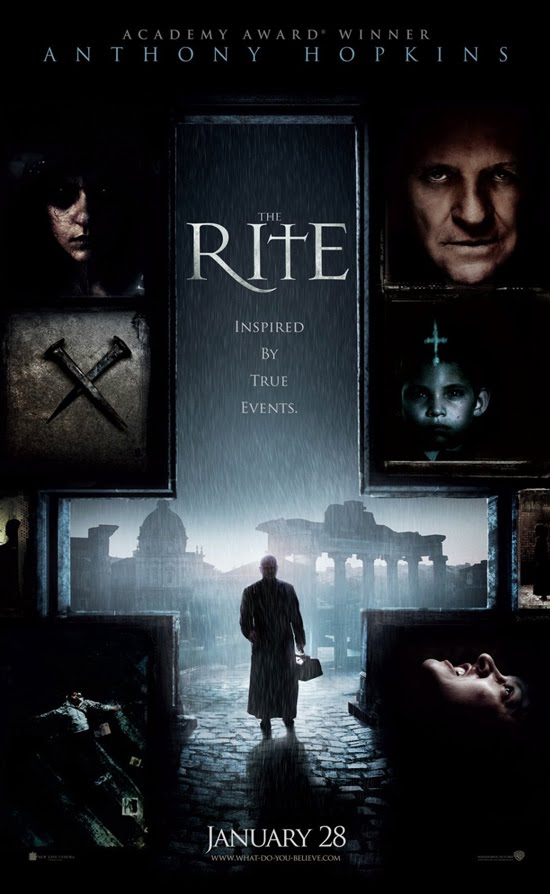
MOVIES: "THE RITE"


“The Rite” is not scary. Not for adults (and I’m a scaredy-cat adult) at least. But it’s a good story with lots of thought-provoking dialogue.

An almost-ordained American seminarian, Michael Kovak (Colin O’Donaghue), winds up in Rome at “exorcist’s school,” but his skepticism and doubts about the devil AND God continue to plague him. His Rome professor sends him off to an unorthodox but experienced and successful exorcist, Fr. Lucas (Anthony Hopkins--in both a brilliant and delightful performance--makes a great priest), in order to be “convinced.” But Michael is a tough nut to crack and remains of the belief that all he is witnessing is psychological pathologies.

The film avoids clichés and puns about the devil, but manages a very sophisticated humor in the face of evil—something that just rings so true. God and humans are fun and funny, Satan is not. He’s kinda angry and takes himself very seriously and is closed to and incapable of any originality.

Is this a film about faith? Yes, but not just religious/theological faith--which it is, explicitly! It’s also about human faith in our fellows, in ourselves, and in where “life” leads us. When we can’t see the total picture, we need to believe there is a “reason,” that somehow things make sense in spite of our limitations, in spite of ourselves, and that we’re all on the way—we’re not there yet—and it’s not terribly helpful to dig our heels in in disbelief. Life is not static. Michael makes the mistake of equating truth with certainty, something no one is entitled to.

Accuracy? The film is “suggested” by the book “The Rite,” by Matt Baglio, a journalist, and the book is based on Baglio’s experiences as he accompanied an American exorcist, Fr. Gary Thomas, through his exorcist’s training in Rome. Fr. Gary was available for interviews to promote the film which I thought was odd, since generally exorcists keep a low profile. But perhaps--with his bishop’s permission I’m assuming--and in an effort to educate (and re-educate) the public about the reality of the demonic, this might be seen as a “catechetical” effort. It's also a bit vocational--not that anyone would or should aspire to being an exorcist, but it shows priests standing up to evil....

The movie gets a few things askew that are probably only irritating to Catholic geeks like myself: 1) the movie keeps talking about Michael getting ready to take his vows. Diocesan priests don’t take vows. They get ordained, and make a promise to the bishop. 2) The devil keeps calling Michael “priest,” but he’s not yet. Maybe the devil respected him like a priest or something, but the devil is pretty shrewd and only obeys ordained authorities. If even that. 3) Um, a doubting, in-a-vocational-crisis seminarian would NOT be sent to Rome to exorcist’s school. 4) The screenwriter couldn’t resist having a little bit of a showdown between the faith/strength of the exorcist and the temptations/strength of the devil. But it’s not about that, even though Satan would love to destroy all people and especially priests and exorcists. It’s about God vs. the devil. But it seems to be so hard for film to take God seriously as a real character, a real person who really acts. But “The Rite,” does not totally miss the mark on this! St. Michael and Our Lady majorly figure in, too, which is quite correct. Who-Is-Like-God? Viva la Virgen! Actually, "The Rite," does a fine, fine job of making spiritual things, the spiritual world, palpable.

Fr. Gabriel Amorth (who is one of our Society of St. Paul priests and former exorcist of Rome) wrote two best-selling books printed in English by Ignatius Press: “An Exorcist Tells His Story,” and “More Exorcist Stories.” I held off reading them for a long time because I felt they would be sensational, and who wants to give Old Scratch any limelight, anyway? But when I read them, they were very instructional about how evil works, even in very ordinary circumstances. Without going into a lot of details, my first encounter with manifestations of a demonic nature and deliverance prayer (NOT said by me) was in the Charismatic Renewal in the 90’s. I was instructed in and read a little about it back then. There are different levels of demonic interference: infestation, obsession, etc. “Possession” is a total taking-over the person by a demon—or as much as a demon is capable of invading a person.

It’s important to know that a person is not always to blame for this interference. The first books I read said there are three ways that the devil gains entrance:

1. Dabbling in the occult or explicitly calling on Satan.
2. A life of unrepented sin.
3. Emotional wounds inflicted by others.

Fr. Amorth added another in his books:
4. We’re not very bad, we’re very good, and Satan tries to stop us from doing more good.

The important thing to remember is that no matter what the case, Satan can’t force our will. As long as we’re alive there’s hope, and often this interference can be healed with the help of the ministry of the Church.

The movie, “The Exorcism of Emily Rose,” which IS scary--based on the true story of a young woman in Germany--bears out #4 above. We might think that getting possessed is the worst thing that could happen to us, and although it’s totally dire, the worst thing that can happen to us is that we freely choose to sin. As Fr. Jeffrey Grob—Chicago’s exorcist since 2006--said in a recent article in the Chicago Sun-Times: “One good sacramental confession is more powerful than 100 exorcisms.”

OTHER STUFF:

--Interesting, good stuff about how a vocation can work in someone’s life, and, indirectly, the call to celibacy for the Kingdom.

--Stuff I question (even for poetic license): “A persistent tremor in a limb” is a sign of possession?

--Love those sourpuss Italian priests and nuns! Ha ha ha.

--True: “Spiritual liberation can take months or years.”

--True: Exorcists don’t always know how things will turn out….

--True: The work of exorcism takes its toll on the exorcist.

--Fr. Lucas gives lots of great advice.

--Movie really brings out how much Satan hates us.

--Movie actually moves a bit slowly in places, breaking the tension.

--O'Donoghue also makes a good seminarian, but is a bit one-tone, one-note, one-mood. Perhaps he could have played it slightly more nuanced?

--VERY interesting how temptations to fornicate are seen as coming straight from hell.

--The devil knows all our weaknesses and sins and knows a lot about a lot of things. Except how to love.

Chicago exorcist: The ‘evil one’ is very real - Chicago Sun-Times


Bookmark and Share

January 10, 2011

MOVIES: "SEASON OF THE WITCH"


“Season of the Witch” is one of those movies that had such potential, but drowns (like the three women accused of being witches in the first scene) under the weight of its own petering out of imagination. The premise was solid, the casting was appropriate, the execution mostly enjoyable: What went wrong?

A frail, pretty young woman (the fetching Claire Foy from “Little Dorrit” whom we’ll be seeing plenty more of) is accused of being a powerful witch who has brought a deadly plague on every town she passes through. Two errant knight-crusaders (Nicholas Cage and the always spot-on Ron Perlman) are charged with bringing her safely to a monastery where she will have a fair trial. So far so good. The best scenes are the subtle, creepy interactions with “the witch,” a harmless looking creature, but as soon as you engage in conversation with her, she will find your weakness and use it against you.*

Without giving too much away, the whole thing climaxes with a ridiculous-looking, goofy, gray winged gargoyle that looks like an enhanced Antz. After tons and tons of supernatural powers and special effects, this wimpy reptilian bad guy can be pinned against the wall in mano a mano fighting with Nic Cage. Yeesh.

There are uneven directing and editing problems, also. So many times I wanted to shout: “Cut! Cut!” And some of the camera movements are so Austin Powers-like, I couldn’t believe the folks in my cinema didn’t burst out laughing. But these missteps occur in the middle of some great, tense sequences, which is a shame. This is not a tongue-in-cheek movie, although there are funny lines. It’s more of a supernatural thriller, with sometimes comic-book-hero action.

The Church is made to look like the powerful worldly entity it was back in the day, and there’s a fair amount of anti-religious barbs and jokes-at-the-expense-of-religion (which, of course, would have been very appropriate to the times, and no doubt, often well deserved). But Hollywood also recognizes the spiritual power wielded by the Church. However, the only hope to stop the darkness is “The Book of Solomon,” painstakingly copied by hand by monks. Oh dear: “Book of Solomon.” At first I thought—professional, informed Catholic that I am—“You mean the real book of the Bible: The Wisdom of Solomon? But how can you slay witches and demons with aphorisms?” I was so confused. Then I realized we were in quasi-fictional Dan Brown territory, because this Book of Solomon, although written and illuminated by monks, is “the book used by all the holy men through the ages” to overcome evil. Ooooh. This isn’t the Catholic brand, it’s generic. Leave it to a nun to spoil all the fun (by pointing this out).

A word about Nicholas Cage. In the first scene we see him in, we think “oh-oh.” He is sticking out like a sore thumb with his distinctly American-casual-diction and “I am Nicholas Cage” presence. My thoughts drifted to Kevin Costner in “Robin Hood.” The cast is mixed with Brits who can make ANYTHING sound like Shakespeare and make you utterly believe ANYTHING they say. I don’t know if Nic Cage can do period pieces. And I like the guy’s acting. I just think he needs really extreme characters with psychological-type quandaries.

Is “Witch” worth seeing? Yes. But I think things are at their spookiest without CGI! Why did the realistic-looking wolves (who were probably CGI themselves) suddenly need turbo-CGI faces? They became LESS scary! This is my beef with Stephen King, too. He sets up these amazing scenarios that get under your skin, and then he jumps to some outlandish, bad drug trip story-line that could definitely never happen in my living-room/house/town/life. And I can no longer relate, and I’m no longer frightened or interested.

Although in “Witch” much is made of chivalry and vows to God--the true nature of evil is never dealt with. The evil of sin that lives in our hearts. There are fleeting references to sin and penance, but actually with a sense of disbelief. In the new book “Light of the World,” Pope Benedict says: “We have to recover the understanding that it is really necessary to come to terms with evil. We cannot simply shove it aside or forget it. It has to be worked through and transformed from within.”

Hollywood gets evil half-right. But we will not be saved by a book. Not even the Book of Eli. We are saved by our relationship with God, the living Word of God.

It’s so much easier to draw a sword and decapitate demons than it is to wrestle the demons within. Interior battles are hard, lonely, unseen, unapplauded and unvalued in our completely external, Twitterized, publish-my-life world. But as Thomas More said in “Man for All Seasons”: God and your little circle around you will notice, “not a bad audience, that.” Want to really man-up? Take up your cross of a life of discipleship, spiritual discipline and self-sacrifice. Only love, truth, beauty and goodness will win the day.

OTHER STUFF:

--*I am tempted to a do a feminist read on the whole female witch thing, but I’ll spare you. Suffice it to reproduce a line of dialogue here: “The witch will turn men against each other.”

--“The greatest persecution of the Church comes not from her enemies without, but arises from sin within the Church.” –Pope Benedict XVI

--Another word to Hollywood about CGI: I hate things morphing into other things all the time. Cease and desist, you shape-shifters!

--Like I said, I don’t believe this movie was meant to be tongue in cheek, so I think it was a bad thing when Monty Python came to mind once or twice.

--“Witch” might even be a candidate for “Mystery Science Theater 3000” because I was reflexively thinking up awesome MST3K lines as we went along.

--Director Dominic Sena also did “Swordfish,” “Gone in 60 Seconds,” and “Kalifornia.”

--The real outdoor settings are spectacular with a mottled color palette of brown, blue, black and white.

--We could have done without the frequent “Happy Trails,” suspender-snapping, horseback reminiscences of the two knights. But Nicholas Cage looked like a good horseman.

--What was with those doctors with the bird beaks surrounding the dying Cardinal?? Looked occult.

--Great line when the merry band realizes the proportions of the evil they’re dealing with: “We’re gonna need more holy water.”

--Good switch from knights killing people to spiritual warfare.

--Some good advice from “Witch” about evil:

Don’t even talk to evil. It’s way smarter than you.

Turn to God and the Church.

Don’t sell relics.

“God will never abandon us.”

“We believe what we want to believe” to our own salvation or ruination.

Satan is the “accuser”—he’s always bringing up our sins before us (and not in a good way, to do something about them, but so that we’ll despair over them).


Bookmark and Share

December 22, 2010

MOVIES: "THE FIGHTER"


The buzz is true. “The Fighter” is a contender. An Oscar contender. If you ever, ever doubted Christian Bale’s acting chops (after those stiff Batman performances—hey, maybe the Batman WAS stiff and Bale is just playing to character)—get yourself to a cinema and be prepared to gape. “The Fighter” (based on a true boxing story) could be either Dicky (Christian Bale), a one-hit (literally) wonder, “the pride of Lowell, Mass.,” now washed up and on crack, OR his brother Mickey (Mark Wahlberg, who puts in an interestingly gentle and almost contemplative performance). Bale totally nails the Boston charmer/wiseguy attitude, Boston accent and mumbling-and-talking-in-bunches which isn’t easy to do. The entire cast gets it, too. Amy Adams, as Mickey’s girlfriend Charlene, latches on to the immediate, in-your-face, rapid-fire, Bostonspeak. Amy plays against type here as a lovely toughie who could probably hold her own in the ring, and is firmly in Mickey’s corner, even over against his family. Melissa Leo—whom we just saw in another Boston story, "Conviction," as the evil small-town police chief—plays the boxers’ scheming manager Mom.

The opening sequence is a wonderful introduction to the love between the brothers, their place in the community, and who they are as people and sluggers. This story never lets you go, there are no lags, only plenty of Oscar scenes, moments and performances, without them posturing to be “memorable.” Masterful movie-making all around. David O. Russell (“Three Kings,” “I Heart Huckabees”—both also starring Mark Wahlberg) directs, and it probably doesn’t hurt that one of the screenwriters is a native of the Bay State and also wrote the gritty “8 Mile.”

Dicky has always coached Mickey, but Mickey’s career is going nowhere and Dicky’s addiction is becoming a liability. Will Mickey stick with family or take advantage of other opportunities? This is the deceptively simple choice Mickey has throughout the movie. “The Fighter” has miles and miles of heart. You almost want to be part of this crazy, brawling, dysfunctional family that sticks together like glue. Almost. The dialogue is some of the real-est, non-stop, conversational banter I’ve heard in movies in a long time.

“The Fighter” is rated “R” for “language throughout, drug content, some violence and sexuality.” The instances of the “F” word are certainly pervasive and it’s used constantly both as an expletive and a verb, but the drug abuse is an object lesson, and “sexuality”? We see Charlene in her underwear, there’s implied sex between her and Mickey, and off-screen oral sex performed on a john by a prostitute in a car. The violence is not excessive or glorified—it’s just what this family does, the family business, almost matter of fact—but the punches during the fights are audio-enhanced to sound like oil drums thudding around inside a cement mixer.

God/prayer/religion are natural and interwoven like they really are in the lives of people of faith. Children are ever-present, and although they don’t have many speaking parts, they are important, precious members of the family who count, and about and around whom important decisions are made (even if the adults are often acting like big kids).

Definitely a feel good movie (after the bruises and cuts heal) about wanting to make your mark in life, and doing it for your family and the place on the map you call home.

OTHER STUFF:

--Make no mistake. This is Christian Bale's movie. Without the character of Dicky (and Bale's embodiment of him) this could have been a middling movie. Bale has managed to make his character a backdrop, a landscape for the whole film, thus enabling the other actors to shine. Amen.

--Sugar Ray!

--Like the actor who plays the pivotal role of the serial killer in “Changeling,” actor Jack McGee does such a realistic turn as Dicky’s and Mickey’s stepfather that you forget he’s an actor, too! (But I could also feel that in real life he is a New Yorker, and so he is. New Yorkers are truly unedited because they have a completely closed worldview--they have it all figured out, and they know New York is a world-class, world-vital city. Bostonians ARE edited because their worldview is not quite closed. For all their bravado they hesitate, they're not sure, they don't have it all figured out, they're still open and they have the "small city," "little brother" complex, especially toward the city of New York.)

--The extremely short epilogue of the real Dicky and Mickey doesn’t say much at all, but is just tastily random.

--“You owe me $200!”

--Christian Bale is a sold-out-to-his-art actor. Period.

--THEOLOGY OF THE BODY? Well, “Fighter” certainly shows how a MAN can be USED for his body, how others can use his body as a commodity to make money. The female prostitution is a sad note. The premarital sex is not taken terribly lightly because both Mickey and Charlene are people of integrity in other aspects of their lives, and Charlene’s main concern is for Mickey to the right thing for himself, and even breaks up with him until he does.

--The soundtrack exposes Michael Brook as a fine connoisseur of the best music of the 70’s (even though the story is set in 1993) and present day. He includes at least two Boston bands: Aerosmith and the DropKick Murphys.

--The way Bostonians (and I’m sure they’re not alone) don’t want their own to get ahead is shot through this movie. (“Thinks she’s superior ‘cause she went to college!”)

Bookmark and Share

December 11, 2010


Bookmark and Share

THEOLOGY OF THE BODY


THEOLOGY OF THE BODY – “LOVE & RESPONSIBILITY”
FATHER THOMAS LOYA – DECEMBER 11, 2010


Metaphysics of love:
Senses – cognition – impression – emotion. Our culture gets stuck at the first two. Feelings are not the sum-total of reality. Our culture has such a hard time understanding this, because it’s all subjective. Feelings are like indicators on our dashboard, they are pointing at something else, asking us to look at something else, take some kind of action.

But our ultimate value should be THE TOTAL PERSON. Our goal is “integrated love.”
There is a kind of backlash today—some couples today are only wanting to use sex for procreation, and do things like having sex in the dark, half-clothed, trying to diminish enjoyment! (But this, too, is a kind of utilitarianism! It would make God utilitarian, also—just using us and not loving us.) There is a belief that all pleasure is bad (p. 59), but the Church has condemned this heresy a long time ago! (Manichaeism).

Sooo…we can’t “use” sex just for pleasure OR just for children. It has to be both, otherwise it becomes utilitarian—even for good purposes! K.I.T.=Keep It Together (see movie “Bowfinger”). Can’t separate LOVE and LIFE. Human beings can even understand how they are PARTICIPATING WITH God, (not being used by God).

The evolution story: “We have sex to procreate and keep the race going” is just a little tiny piece of it and doesn’t take into account the whole person, and is not EVEN utilitarian, because nature is blind and can’t have a will or purpose!!!

Advent/Christmas is nuptial: God, the Bridegroom coming to wed the Bride, HIM coming to participate in OUR humanity, wedding humanity to Himself. And this is directly connected with our sexuality, because it’s about INTIMACY AND INTIMATE UNION. The whole liturgical year is ONE MOVEMENT: even the gifts of the Magi foreshadow his death and resurrection.
The Church Fathers called Christmas “the great condescension.”

Q: “What’s the morality of participating in erotic, racy love scenes in movies, because you’re supposed to enter into the experience of the character?”A: “Know yourself, monitor yourself.” There are layers of insincerity in a sense there. Those actors are not really in love with each other. [Other levels of insincerity with body doubles also!] All acting is “lying,” in a sense. The author of TOB was an actor and playwright! [Aristotle believed in acting, Plato did not.] [Sr. Helena thinks there’s a lot of work to be done in this area, now that we have TOB.]

There is something unique that happens in “love between man and woman”—they develop to a fulfillment of themselves as persons. This kind of going out to the “other” does not happen in same-sex relationships.

p. 78—If “love” is based only on attraction/feelings (which are of their nature fleeting!), we are basing love on something fleeting! Sometimes we project qualities on people that aren’t there.
Father said he is counseling couples who are not married (pre-marriage counseling) as though they are because they are living together and living a married lifestyle! And usually, the man doesn’t want to commit and the woman is trying to get him to! [WE THINK WE ARE BEING SO “NATURAL” AND FREE, BUT WE ARE WORKING AGAINST NATURE BY SEX OUTSIDE OF MARRIAGE. NO SEX BEFORE MARRIAGE MEANS THE MAN WILL BE BONDED TO THE WOMAN AT MARRIAGE.]

FATHER TELLS THESE GOOD YOUNG CATHOLIC MEN (who aren’t even having sex before marriage): IF YOU’RE NOT SEEKING MARRIAGE, DON’T DATE. YOU’RE HURTING THESE WOMEN.

COUPLES LIVING TOGETHER BEFORE MARRIAGE HAVE A HIGH DIVORCE RATE because they’re playing at something and expecting to derive the full benefits by only going halfway. THE MAN IN PARTICULAR DOES NOT FEEL THAT THIS IS AN EXCLUSIVE RELATIONSHIP (AND RIGHTLY KNOWS THIS BECAUSE MEN ARE MORE ABOUT EXTERNALITY). We need to just keep affirming that 1) you want true love 2) God wants you to have true love 3) HERE’S HOW TO GET IT....! [“Sex and the City” is all about that: wanting the benefits of commitment without the actual commitment: trying things out, trial run, etc.]

Young couples today are good at the subjective but terrible at the objective! Perhaps couples of the past were good at the objective, but not so good at the subjective. JP2G says: feelings are GOOD, but is that ALL there is?

p. 79--Don’t do the… “I love you because….” No. We love the WHOLE person, not just their qualities.

In counseling, Father asks couples having problems: Go home and just look at each other as a Christian man and Christian woman in a Christian home (forget that you’re married). What does that mean in everything you do and say? What would a day in the life of the Holy Family be like? What’s your real family life like? How do I get them to match? (3 sheets of paper) It’s called a “family covenant” because it’s above everyone and everything. It’s higher than all those involved.

Q: Should couples get married younger?A: Yes—the vocational part of life (wife, mother, religious, husband, father, priest) is put on hold for a long time. And then the reversion to the faith happens, the vocation rises up. It’s almost a new area of ministry. [New York City has become a city of singles!] It takes a harder toll on women, in a sense, because they are told you must have a career (whereas men would be working/providing for the family anyway) and then they get totally involved in that, and motherhood requires a much greater commitment/cost/involvement physically, etc., on the woman than fatherhood does on the man, the biological clock for women is much shorter, juggling career and motherhood is much more difficult for women, etc., etc.


Bookmark and Share

December 8, 2010

FIRST EVER U.S. MARIAN APPARITION APPROVED TODAY! FROM GREEN BAY, WI, 1859

Our Lady spoke about evangelization and catechesis!


Bookmark and Share


MOVIES: "WARRIOR'S WAY"


At first I thought I was watching the worst movie of 2010. But it somewhat ameliorated itself. But the beginning is a true mess. On many levels. “Warrior” should have scrapped the beginning and made it match the rest of the film—it was finding its way for a long time, dragging us along, embarrassed for it. Writer-director Sngmoo Lee offers up a martial arts film (“Crouching Tiger” style) with a surrealist twist. But it’s also a Western. And a comedy. And it doesn’t really work. The U.S. Bishops/Catholic News Service http://www.usccb.org/movies/ gave it an “O” rating, that is, morally objectionable, and I agree.

Yang, a ninja warrior (South Korean actor Jang Dong-gun—a fine thespian) spares the life of a baby princess from a rival tribe (this baby, Annalin Rudd—cutest on film since “Babies"--is somehow actually acting, and with better reaction shots than many of the adult actors!), and flees to America’s Wild West to hide. He runs a laundry, plants a flower garden, and meets tomboy Lynne (a little too precocious and precious Kate Bosworth, but it was a tough role) to whom he teaches the art of fighting with knives and swords.

The town is filled with all the usual suspects: the town drunk (the awe-inspiring Geoffrey Rush—what in tarnation is he doing in this film?), the savage U.S. Calvary Colonel (Danny Huston, who surpasses even Dong-gun’s quality performance—no wonder: his father is director John Huston, his half-sister is Anjelica Huston), the midget from the circus (Tony Cox), etc., who don’t really seem to have much of a connection to each other until the final showdown when they band together to save their collective necks.

There is much (even some mostly-hinted-at sexual) sadistic violence and carnage. The long end-battle is pure, gratuitous, choreographed, ain’t-it-cool violence. What’s most disquieting is that cute-as-a-button Lynne (because her whole family was murdered) has a huge taste for revenge that the usually quiet and dignified Yang makes sure she gets to satisfy. But, we shouldn’t be too surprised at Yang, because he is a trained assassin who must “destroy everything he loves,” and his ninja-master comes to the land of the free and the home of the brave to remind him so.

The love story build-up is slow and sweet as the lovers get to know each other as persons, and each other’s deepest values/dreams. There’s a lovely scene in the desert under the stars where Yang and Lynne do a kind of romantic dance with swordplay. Films are supposed to find new ways to say: “I love you” and “Warriors” does. Quite well. Until….

The ethic at the end—which has been simmering all through—is so profoundly unChristian, un-life-affirming and un-Theology-of-the-Body (but so are many classic Westerns!) that nothing short of a round rejection, a sounding “strongly disagree!” is in order. Or, as the movie would say: We should “put the greatest distance between” ourselves and this film.

OTHER STUFF:

--Why is “Warrior” un-Theology-of-the-Body? SPOILER ALERT! Because the man walks away from family. St. Joseph STAYED, people! Mary and Jesus needed him. WITH them.

--From a recent book review I did of “Myth of the American Superhero”:

The American Monomyth:
“A community in a harmonious paradise is threatened by evil; normal institutions fail to contend with this threat; a selfless superhero emerges to renounce temptations and carry out the redemptive task; aided by fate, his decisive victory restores the community to its paradisiacal condition; the superhero then recedes into obscurity.” (p. 6)

The authors contend that the American Monomyth of heroic redemptive violence is unique to America by contrasting it with the “Classical Monomyth”:
“A hero ventures forth from the world of common day into a region of supernatural wonder: fabulous forces are there encountered and a decisive victory is won: the hero comes back from this mysterious adventure with the power to bestow boons on his fellow man.” (p. 5, from “The Hero with a Thousand Faces,” Joseph Campbell, p. 30)

One of the main differences between the Classical/American Monomyth is that in the Classical Monomyth, the hero returns as an integrated, mature adult to the community, who can serve in new ways, whereas the American Monomyth portrays a lone, celibate [the authors use the term “sexless” which I believe is inaccurate] hero who disappears.

Some say that Americans are living in a “postmythical” culture, but the authors disagree. They believe there is a clearly recognizable mythic pattern in American pop culture artifacts (films and TV) such as Rambo, The Matrix, Star Trek, Star Wars, Left Behind, and even Touched by an Angel.

The American Monomyth derives from tales of Judeao-Christian ideas of redemption (linear) rather than pagan (circular), and secularizes them, makes them about temporal matters only. The “supersaviors” are replacements for the Christ figure.

--At least the fighting (which I do not enjoy, unless we’re talking hockey here) is artistic. But so much surround-sound-blood-gurgle-spurting and heads-popping-and-rolling and throats-slitting that it rivals “300.” Yeesh.

--SPFX did nothing for me. But then again, they never do. I’m convinced that SPFX are almost totally a guy thing. We women are in it for the drama, emotions, romance, story.

--Annalin Rudd (the baby princess) is just such a natural! Her parents must be very proud.

--Every time I harshly review movies, I ask myself: And what have YOU produced???

--The most peaceful person I ever met was an AAA guy in Los Angeles when my alternator exploded on the 405 late at night. I mean, he had those imperturbably peaceful eyes like Yang, and it turns out he was a serious practitioner of Aikido.

--Cinematographically, the close-ups are great. Lee really excels at close-ups.

--Good soundtrack.

--“Gallipoli” is one of the best war films ever made. Shows the reality. The fragility of human beings. That we are not made for war. (Not even the toughest of warriors.)

--There’s something just wrong about women-warriors, killer-girls. When did we start to see a proliferation of them in film?

--Anachronistic automatic weapons in the old-time Wild West. Seems to be the only anachronism in the movie. Just had to ratchet up the mayhem I guess. The rhythmic pounding of the “artillery” almost becomes a sick* soundtrack at a certain point.

--Kate Bosworth is very pretty.

--When Yang is young and in training, his ninja-master tells him his heart isn’t hard enough, that he has the heart of a “priest.” Hmmmm.
_______
*original meaning of word “sick,” not “cool”

Bookmark and Share

December 5, 2010

NUNS' FAVORITE NUN MOVIES

A real nun: Sr. Mary Thecla, fsp

1. “The Trouble with Angels” 1966/”Where Angels Go, Trouble Follows” 1968—“Showed different personalities in community, how we’re not perfect, how virtues like patience are needed.” Some liked the sequel better than the original. Others didn’t like the sequel at all. “Rosalind Russell potrayed a mother superior who was a blend of strength and sisterly love." “This movie STILL wants to make me be a nun” (from a Sister in religious life over 40 years). “Realistic enough.” “This movie has endured.” “Rosalind Russell expressed the right emotions at the right times.” “Great nunny, idealistic, can-do, spunky spirit. Nuns aging gracefully.” "Nuns loving and forming a generation of younger women who will not share their lifestyle, but the nuns don't look down on the pop culture, they just give the young ladies values and inspiration."


2. “Sound of Music” 1965—“The mother superior was inspiring.” “Mother superior’s theme song ‘Climb Every Mountain’ is a great summation of religious life.”

3. “Song of Bernadette” 1943 (winner of 4 Oscars!)

4. “Bells of St. Mary’s” 1945—The sisters don’t seem to mind the maudlin movies as opposed to the priests who do not suffer them at all. They somehow find them inspiring before and after entering the convent themselves. The question here also is: Was the Church “acting” like this and was Hollywood “reporting”? Was society a little more actually “like this” at the time? Was there a certain earnestness, high ideals, keeping up of appearances, perhaps some denial mixed in? Was American society as a whole truly more innocent and simple as depicted? Remember, these movies were made on the heels of the Depression (when the cheeriest songs ever written played on the radio to keep people’s spirits up: “Always Look for the Silver Lining,” “On the Sunny Side of the Street,” etc.) and World War II.

5. “Doubt” 2008—Several sisters agreed this was realistic to the times it portrayed (and of course, this is the overwhelming consensus of anyone who did the Catholic school experience of these times), and several mentioned the “gristle” scene as very true! Sr. Aloysius also rocks the casbah.

6. “Come to the Stable” 1949 

7. “Dead Man Walking” 1995—“The most realistic/authentic, best-developed character of the reality of a particular nun ever.”

8. “Heaven Knows, Mr. Allison” 1957—“More realistic than most.”

9. “Sr. Act I” 1992—Nuns always mention the freezer-raiding scene for ice cream as very realistic. (Also, the songs about Jesus being our honey are the heart of religious life.)

10. “Painted Veil” 2006—(Diana Riggs as a nun again!) “Wise, down-to-earth mother superior.” One nun liked this line from Mother Superior: “When love and duty are one, grace is within you.”

11. "Entertaining Angels--The Dorothy Day Story" 1996--Sports an intelligent and engaged nun who can match wits with the pre-conversion Dorothy Day.

Bookmark and Share

November 24, 2010

NOVEMBER 26--FEAST OF BL. JAMES ALBERIONE, SSP


Bookmark and Share

ALBERIONE FILM: DIRECTOR OF PHOTOGRAPHY FEATURED ON SONY WEBSITE!

Danny Hidalgo, dp for the Alberione film, has been featured along with Spirit Juice Studios on Sony's video equipment website! Sony VideON Biography - Daniel Hidalgo Check out Danny's work on music vid "Move Merchants," then arrow right to watch Rob Kaczmark's "To Be Born" trailer, a pro-life short. (I've seen a rough cut of the 17 min. film and the trailer doesn't even begin to do it justice.) We're so proud of Rob and Danny and so grateful to be working with them!
Danny is on the Appian Way here, recreating the Apostle Paul walking into Rome....


Bookmark and Share

November 23, 2010

MOVIES: "FAIR GAME"


“Fair Game” is one of those very-recent history movies, based very tightly on a true story. It’s actually two stories evenly balanced into one: that of Ambassador Joe Wilson (Sean Penn looking all Michael Douglas-y) and his wife, CIA operative Valerie Plame (Naomi Watts). These two distinguished actors knock their respective roles out of the park.

The historical anecdote is, of course, the lie that started a war. The lie that Saddam/Iraq had a nuclear program, was enriching uranium and had weapons of mass destruction (WMDs). The “proof” was that the country of Niger had been providing the materials—something Joe Wilson disproved on a fact-finding mission. In retaliation for Wilson not going along with the “program” to get the war on, and instead turning to the news media to out the lie, Valerie’s identity was revealed to all the world by none other than the White House/U.S. government itself.

This action of disclosing the identity of an American spy was illegal, and although the chain of command went all the way up to the Vice President, it was underling Scooter Libby who eventually took the fall.

Since the start of the Second Gulf War took place almost ten years ago, this film can be very instructive for younger people who did not live through these events, so fresh in older minds. In fact, there is a movement in education to use these types of films in history classes—while simultaneously checking the films for accuracy and comparing them with reality. Many actual TV newscasts of President Bush and others are heavily interwoven throughout the film.

All is pretty much exactly as I remembered it unfolding. Even the mood of the country is recreated: the fear and panic right after 9/11, the patriotism, the accusations of disloyalty to America and the troops if one was against going to war, the fact that 50% of Americans thought Saddam had attacked the Twin Towers (making the connection as they heard the war drums rattling every day in the media), the “shock and awe” as the bombing of Baghdad began. Another comment is made about us recently having been allies with Saddam during the Iran/Iraq war: “We put him there.”

This incident was a pretty clear-cut one. Other news stories can tend to get all murkified and we wind up with what one character says in denial and defeat: “Who knows what really happened?”
Much of the film centers on what the stress of it all did to Joe and Valerie’s marriage, their decision to fight, their love of country, their love of truth. (One does have to ask, however, about the truthfulness of being a spy! The filmmakers must have anticipated this, because at one point, Valerie is asked how she can look people in the face and lie, and she responds: “Know why you’re lying, and never forget the truth.”)

Both Joe Wilson and Valerie Plame have written books about their experiences.

OTHER STUFF:

--What is it with the name “Wilson”? (“Charlie Wilson’s War”)

--I just realized how much my friend Michelle Halm looks like a raven-haired Naomi Watts. And have told her so.

--I bet Sean Penn loved making this movie and “sticking it to the man.” Ha ha. Although I don’t care for his leftie politics, I applaud him profoundly for his humanitarian work: Katrina, and especially Haiti.

--Fascinating brief (real) footage of skeptical faces of the representatives of various countries at the U.N. as Bush makes his case to go after Saddam.

--Do NOT invite Joe Wilson to your next dinner party.

--The great title is a quote from Karl Rove who said: “Joe Wilson’s wife is fair game.”

--I really admired Joe Wilson when he spoke out. He really was all alone. I’m glad he has a movie now.

--If you like “Fair Game” you’ll like “Spy Games” (fictional) with Brad Pitt and Robert Redford, about how the U.S. sometimes treats its friends, what spying might be like, and what the spy might ultimately have to do to avoid their own government.

--Other good Iraq/Afghanistan War movies: “Brothers at War” (documentary), “Restrepo,” “Three Kings” (1st Gulf War—heavily watched by soldiers DURING the 2nd Gulf War), “Jarhead (1st Gulf War),” “Hurt Locker.” I have reservations about all these movies, however, because none really show the horror and repercussions of war.

--THEOLOGY OF THE BODY? A beautiful portrayal of getting through extremely tough times in a marriage.

--Saw this film in Boston—a very politically-active, ideological city. Mostly upper middle-aged audience. There was a kind of reverent silence during the whole thing and the audience didn’t move till halfway through the credits. I love my people. :]

--Great speech at the end about what it means to be an American.

--As much as I was (and am) against the war in Iraq (and women in combat!), even I got swept up for a few days with that amazing photo-op of the young blonde female soldier being handed a flower by a grateful Iraqi woman as the statue of Saddam was pulled down in Baghdad. The power of image, the power of narrative, the power of wishful thinking, the power of nationalism, the power of interpretation, the power of power.

--Can someone please tell me why we REALLY went into Iraq?

Bookmark and Share

November 13, 2010

"LOVE & RESPONSIBILITY"

“LOVE AND RESPONSIBILITY”—FR. THOMAS LOYA—10/13/2010


p. 45--“Instinct”and “urge” mean the same thing more or less.

Man is capable of rising above sexual “instinct” and other “instincts.” The sexual urge is the strongest of all urges because it has to do with our very EXISTENCE.

The sexual “urge” is a "vector of aspiration from which the human person grows and perfects themselves from within." When we live according to the sexual order, it orders our whole being and we progress and grow. E.g., a man becomes fully a man only in relation to woman (not just an individual woman, but, e.g., a priest toward the Church, the feminine). A priest’s relationship to the Church perfects both himself and the Church. IT MUST BE COMPLEMENTARY IN NATURE for the perfecting to happen. A man cannot fully perfect another man.

That’s why our sexual drive is so strong—because it’s what perfects us in every way! People attack Christopher West for being “too sexual” in his presentations, but actually, we are not “sexual” enough! We have to be like God, more like God. How? Through love and life which is what our sexuality is all about.

We are not responsible for what occurs independent of our will in the sexual sphere (senses and emotions), but we are fully responsible for what we do with it (sense and emotions and will).
To understand ourselves in terms of the spousal element of our being is to understand everything about ourselves. Gender has a revelatory nature. Our genders reveal God!
What about hermaphrodites? (Who prefer to be called “intersex” today.) Doesn’t change anything. Even though it’s a kind of departure from the norm, it doesn’t change anything about the fundamental order of creation or human nature. The fact that we talk about it as an exception also shows this. But hermaphrodites are also sexual/spousal beings! They too, need to make a gift of self! (And receive the gift that others are.) Everything “TOB” applies to them, too. Even if our bodies/sexual organs, etc., aren’t perfect, it doesn’t matter, because sexuality isn’t just physical, it’s also spiritual/emotional/psychological/social!

A human male is attracted to the whole value of what is feminine, not just her body for “reproduction” like the animals. Same for the woman attracted to a man. We each have a value that completes the other. It’s not just about mating and sexual satisfaction.

To talk about sexual “orientation” is amorphous/too generic, we are attracted to a specific PERSON (or should be). It’s personal. [Sr. Anne: A woman who was in a lesbian relationship for many years eventually married a man and had kids. She says she is still not attracted to men. She is only attracted to her husband.]

LOVE is a phenomenon of people only, not animals. It’s fundamentally different FROM the sexual urge. It involves the whole person. Love is given its definitive shape by acts of the will at the level of the person.

What should couples do/not do when dating? BE HONEST TO THE SITUATION. Are you really going to get married? Don’t treat dating like mock-marriage, marriage-lite. It’s not. Only marriage is exclusive. Don’t treat dating like it’s marriage. Maybe not even call it dating, call it “friendship,” and once it’s a solid Christian friendship/brothers & sisters in Christ [“Today I marry my best friend” is a great marriage-sentiment!], you can advance to “courtship” because you’re purposefully heading toward marriage. If you’re not thinking about marriage, don’t get so intimate (of course not sex, but also not the other intimate demands that marriage would put on each other: call me every hour, don’t even look at other women/men or talk to them, etc.). Don’t put each other in an either/or situation: Either this leads to marriage or I’ll be heartbroken. This is also why too much physicality will BOND you to each other and make it very, very difficult to break up even when you should!

Our world says: If you don’t act on all your urges, it’s unnatural! But the truth is the opposite! AS HUMANS, it’s unnatural just to follow our urges! It’s natural to HUMANS to regulate our lives according to our WILL, exercising our WILLPOWER.

[Our culture is both BLINDLY SUBMITTING TO NATURE (but only in our sexual instincts), and REBELLING AGAINST NATURE (in things like contraception and natural conception), and CRUSHING/CONTROLLING/MANIPULATING NATURE (genetic engineering, pollution, raping natural resources). Why do we have to treat Nature as Sacred? Cause it’s all we got! God made it and is working through it. The invisible—the spiritual and divine--is made visible through the physical.

For since the creation of the world God’s invisible qualities—his eternal power and divine nature—have been clearly seen, being understood from what has been made, so that people are without excuse. –Romans 1:20

Through faith we perceive that the worlds were created by the word of God, and that what is visible came into being through the invisible. –Hebrews 11:3

The Son is the image of the invisible God, the firstborn over all creation. –Colossians 1:15]

NFP—to use unnatural means to contracept damages the love-relationship between persons and that’s why it’s wrong. [Because it’s going against the nature of the act, the nature of love which is SACRIFICIAL. It must start with our love of/TRUST in God, otherwise we’re NOT going to trust Him with this huge area of our lives. We need to make room for God!]

Everything rises and falls on what goes on in the bedroom, that’s why we WANT God and the Church in the bedroom! The bedroom is the sanctuary of the human race. The woman’s womb is a tabernacle which the man must approach as a priest approaches the tabernable.

If we’re contracepting, you’re not just doing it in the bedroom, we’re doing it everywhere else: “contraceptive mentality.” [Closed to God, closed to "the other," closed to anything I don't tightly plan in my own life.] Soooo…one can practice NFP with a “contraceptive mentality” if one is totally closed to life.

It’s not biological determinism…it’s God’s Creation/Order working through “biology.”

Q: Do you have to accept God to accept the natural order/natural law?A: No, but it helps.

National Catholic Bio-ethics Center shows all the science that is being suppressed (e.g., the contraception/abortion/breast cancer link)! The National Cancer Institute is adamantly suppressing this stuff!

Q: How define natural law?A: Our objective and subjective interaction with Nature. [And we ARE Nature, too!] VJP2G said: We are subject and object at the same time! We are subject to Nature, and object IN Nature, but we can also step back and reflect on our existence as the acting person/subjective subject that we are.

[VJP2G does use human experience as a starting point—the phenomenological method--(but AUTHENTIC experience). This is how VJP2G purified Kant! We can do things wrong for years and then say: “But this is my experience.”]
Fr. Loya: That’s what’s meant by a totally, totally HONEST and thorough examination of our experience….


Bookmark and Share

November 11, 2010

MOVIES: "RED"


“Red” is a good time. A bloody good time. There’s tons of shooting and violence, but come to think of it, there’s not much blood, only a sizeable body count. This is tongue-in-cheek violence—not even earnest violence-as-entertainment, but violence as comedy. Am I making any sense? See, R.E.D. means “Retired and Extremely Dangerous.” Bruce Willis (Frank Moses) is R.E.D., the best C.I.A. agent that ever there was. He and his cronies (Morgan Freeman, Helen Mirren, and king-of-quirk John Malkovich) come out of retirement because something fishy is going on involving a hit list, a 1981 cover-up in Guatemala, and the Vice-President of the United States of America. Oh yes, and Frank takes along Mary-Louise Parker (Sarah)--a mousy government phone operator who reads spy-romance novels--whom Frank has been crushing on. (Willis and Parker are a delightful comedy-action team.) All Sarah can say is: “Wow!” as she lives the dream.

If you don’t like violence (ridiculous or not), you won’t like “Red,” and you especially won’t like seeing Helen Mirren firing round after round after round of machine gun volleys (she also expertly fires other automatic weapons) in her white evening gown. (At a certain point the noise was rivaling “Public Enemies.”) Me? Because this movie is from DC Comics—although our heroes don’t have ANY superpowers—the tenor of the violence just didn’t faze me one iota. I didn’t, like, WARM to the violence, or laugh at it (except the “real estate agent” with the RPG on her shoulder). Oh dear, maybe I’m jaded. Maybe there’s something in me like there is in Helen Mirren’s character who pretends to be content with flower arranging in her retirement, but finally admits to taking contracts on the side because she “misses the excitement.” But I wouldn’t want anyone to get hurt. And I certainly wouldn’t kill anyone. But the excitement part is attractive. Oh dear. Even truer confessions: After watching the trailer, I DID want to see Helen Mirren fire a gun. Oh dear.

Karl Urban plays William Cooper, Frank’s active C.I.A. nemesis, to perfection. You just can’t take your eyes of this guy he’s SUCH a good actor. Audiences should clamor to see more of him. At a certain point I realized one of the reasons he stands out. It occurred to me: this guy is hiding an accent. He’s dropping “r’s.” Sounds Australian, but could be British. Turns out: New Zealand. He doesn’t hold himself like an American, he doesn’t gaze like an American actor, doesn’t walk American, doesn’t make American facial expressions, doesn’t phrase American. There’s an intensity, a stick-to-the-part-like-glue quality about his acting that is more British. Anyway, he’s great. And he has “cute hair” (Frank Moses).

We are here, there and everywhere in “Red”: Chicago, New Orleans, Virginia, Florida, NYC, introduced by cheery postcards and local music.

Beneath the jocularity is a serious message about what our C.I.A. really does and is capable of. As in movies like “Syriana,” there’s a division between good guys and bad guys in the government system, and in “Red,” the real bad guys are the arms dealers, the private sector, the defense contractors. There’s a repeating Hollywood message here about how America can still be “good”: if individuals, even within corrupt systems, can do their conscience, do the right thing, and of course, put love and family first, and sacrifice all when required. Perhaps this is a much more sober movie than it originally appears to be. We’re not supposed to laugh at any of the true tragedies (like a massacre in Guatemala), but we are supposed to laugh at everything else. As Oscar Wilde said: “If you’re going to tell someone the truth, make them laugh. Otherwise they’ll kill you.”

Sometimes it feels to me like America is “whatever we want it to be.” Like we’re making everything up as we go along. Especially in our storytelling, in our American imagination. And I just kept thinking while watching “Red” how familiar we are with weapons of war (large-scale warfare is carried out in domestic settings in “Red”), and is it just a coincidence that we are fighting two wars right now as more and more violent movies (it seems) are hitting the theaters and I see every day in the news some other young Chicagoan or Illinoisan who has given their lives overseas? The attitude in these films (as well as all the uber-violent previews before the movie) seems to be: “It’s just violence.” Could Hannah Arendt’s “banality of evil” be applied here?

OTHER STUFF:

--Why isn’t “Red” in IMDB?

--Quite a few laughs in this movie.

--Kidnappee to kidnapper: “You can’t just go around duct-taping people. People are basically decent: talk to them.”

--This could have been a one-joke movie: Elderly C.I.A. operatives back in action. But it’s not. Not even with 93-year-old Ernest Borgnine in charge of a C.I.A. archives so secret it doesn’t exist.

--Frank’s entire house—decked out for Christmas--is COMPLETELY, COMPLETELY decimated by black ops. And it doesn’t even wake the neighbors.

--John Malkovich looks very old. And he’s only 57. And it doesn’t look like the make-up.

--A mildly-grisly hanging scene didn’t bother me. I’m beginning to worry about myself.

--Frank is accused by Victoria (Helen Mirren) of being “gooey on the inside.” Hmmm. Thinking of Theology of the Body, maybe that fact that our bodies are physically “gooey” on the inside is a message that we SHOULD be “soft” on the inside—vulnerable, malleable, able to be moved, tender….

--This is a good, OLD-fashioned spy-caper-comedy. People of a certain age will enjoy it more than others, being more familiar with Cold War and Vietnam War era tropes, as well as the aging actors. Mature, youth-challenged people were whooping it up in my theater.

Bookmark and Share

November 8, 2010

THEOLOGY OF THE BODY & THE NEW EVANGELIZATION

“The New Evangelization” is a term coined by Ven. John Paul II the Great to describe the current-day need for the evangelization and re-evangelization of countries and areas of the world that are historically Christian, but for various reasons are no longer so, or are Christian in name only. Pope Benedict XVI has taken up this clarion call with regard to Europe in particular, as he witnesses Europe’s attempts to deny even the factuality of its Christian roots. Pope Benedict even instituted a “Pontifical Council for New Evangelization” this year.

The “re-evangelization” of countries is not new. There are precedents wherein a country/people received the “kerygma” (the initial proclamation of the Gospel) from early missionaries, but the local Church was: left without pastors, lacked a systematic structural development, reverted back to native religions, fell into heresy, fell away, converted to other religions due to invasions, etc. The parable of the Sower and the Seeds is very applicable here! India claims to have received its kerygma from the Apostle Thomas himself. England received the Faith early on but was in need of re-evangelization soon after. The Potawatomi Indians in Michigan were baptized by a missionary priest and taught the Our Father in Latin, but did not see another priest for many years (their recitation of the Our Father was proof of their baptism to subsequent missionaries!)

What does John Paul II’s “Theology of the Body” have to do with his “New Evangelization”? Everything. Although he did not connect the dots himself --most likely out of modesty*—the correlation is vital, at least for Western civilization. How so? There is no evangelization without the evangelization of culture. Individuals belong to cultures, and the Gospel must not only transform the individual but the culture through “inculturation.”

Why the need to evangelize cultures? “Culture” is everything that makes us human: art, work, recreation, leisure, athletics, family life, rites of passage, social networks, politics, food, dance, literature, drama, rituals, and above all, worship. For the Gospel to “stick” and be effective, it must permeate all these areas.

Today, “pop culture” is the dominant culture. Some would call it “American culture” or “media culture.” Some disdain pop culture as “low culture” versus the “high culture” of classical music, the “great books,” etc., but the fact is, the pop culture has all the earmarks of a bonafide culture. And it’s the ONLY culture many young and not-so-young people claim allegiance to.


I was just in Milan/Rome, and guess whose face is EVERYWHERE: on billboards, T-shirts, calendars, even in religious shops? Marilyn Monroe. Everywhere. (Pop culture can also be retro-chic!) As VJP2G also said: “Man is the way of the Church” (Redemptor Hominis). We do not have the luxury to hang back, stand aloof from the roads that the masses travel on. We must “duc in altum,” “put out into the deep,” put out into the wild and wooly watering holes of the pop culture if we are to bring and be Christ, Way, Truth and Life to souls.

As Vatican II taught us, there are “seeds of the Gospel” present in every culture. There is a need to “baptize” what is already good in a culture and “purify” what is not. What are the “seeds of the Gospel” present in today’s Western, so-called “post-Christian” and pop culture? A fascination, obsession, and unswerving commitment to the body, the sensuous, the material, the beautiful, what can be seen, felt and experienced. And John Paul II said: Fine. We can start there. This was VJP2G’s genius in his Theology of the Body. Instead of STARTING with the spiritual, the soul, the mind, consciousness, i.e., what CANNOT be seen, he said: Let’s START with what we CAN see. The physical. The body. As VJP2G’s official biographer, George Weigel, notes, the Theology of the Body has and will continue to turn the entire theological and philosophical world (secular and religious) upside down (or right-side up!) by giving it a new starting point. A universally verifiable starting point. And this starting point cannot be divorced from God because it is Creation and Creation is a doctrine and now we are squarely in the lap of God.

But didn’t we always start our catechesis with Creation? “God made the world”? Yes. However, we Western Catholics are card-carrying members of our particular Western culture which is “Cartesian,” that is, which espouses and lives out of a mind-body split at its very core (see Waldstein’s Introduction to the new edition of the Theology of the Body, “Male and Female He Created Them”). This flawed philosophical underpinning undermines and overrides whatever we are taught by the Bible and the Church, and guides our everyday choices.


The fact of that matter is: We do not HAVE bodies, we ARE bodies. We are embodied spirits and spiritualized bodies. The definition of the human person IS body and soul, together forever.


Is Theology of the Body something new or something old, then? It’s both. It’s a new synthesis of eternal truths. John Paul II, a master catechist, has arranged the deposit of the Faith in such a way that it is immediately accessible to all, because he starts where we all live: our bodies, love, relationships. Jeff Cavins says that what we learn about our Faith through the years often amounts to a “pile of Catholicism” that might even seem like a bunch of true, but unrelated facts. John Paul II has taken the jigsaw puzzle box of the Catholic Faith and assembled the pieces together so that we can see the beautiful complete picture and plan of God for the human body, the human person, centered around Creation/Incarnation/New Creation. Now we can see how everything is interconnected: how the Eucharist connects to Marriage, how the Magisterium connects to the Church’s social teaching, how the Liturgical Year connects to our cycles of fertility, etc. As Fr. Thomas Loya says, “The Theology of the Body is the delivery system for the sum-total of the Church’s wisdom.”

Perhaps we could even say that the Theology of the Body IS the New Evangelization—both content and method.

__________
*Although modesty is a virtue WITHIN the Theology of the Body, there is no need to be modest ABOUT the Theology of the Body. :]


Bookmark and Share